

Peek behind the scenes at MODU System and see how the KR DELTA excels in hygienic food production applications.
(video: KUKA)
Increased hygiene requirements, sustainable solutions
Hygiene is fundamental to food safety, and It’s also a challenge in the food industry, with increased requirements for production areas, cleaning and disinfection of surfaces and equipment, and trained and healthy staff. Malaysian system integrator MODU System supports food producers with expertise in robot-based automation solutions – and assistance from KUKA, which offers the ideal robot for these requirements, the hygienic robot KR DELTA. “We want our customers to have confidence in us,” said Rajinderjit Singh, Regional Manager of MODU System. “That’s why we have invested considerable resources in technology development and work closely with partners like KUKA to find a more sustainable solution for robotics.”
Pick and place: it’s a scoop!

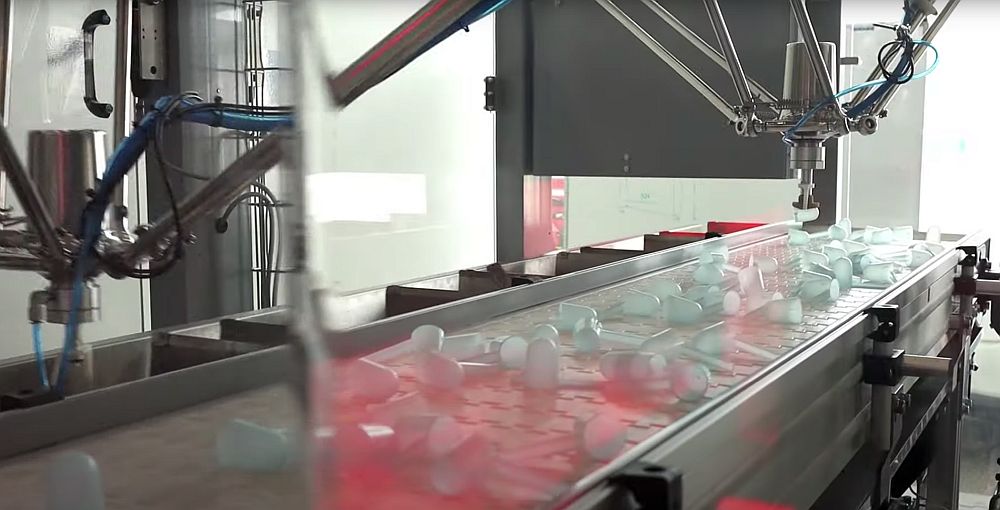
In Klang, west of Kuala Lumpur, two KR DELTA robots pick up measuring spoons from a conveyor belt and place them on a second belt in open conveyor pockets, each holding a food bag with baby food. In a free area next to each bag, a sticker includes a bar code. “When the robot detects the free area via the camera, it knows to place a spoon there,” said Singh. Another machine then pushes the bag and spoon into a box. To avoid machinery jams during packing, the robot doesn’t place a spoon if the food bag covers the sticker. What sounds relatively simple actually represents the hand-in-hand interaction of various systems in ongoing production.
KR DELTA scores in the food industry

“Naturally, the solution centers on the KR DELTA, which can come into direct contact with food because of its stainless steel body,” explained KUKA employee Lim Jia Ming. The robot’s corrosion-resistant stainless steel housing is designed according to German LFGB andUS FDA food standards. It also meets three sets of certifications: European CE,American UL and German TÜV safety function certification. The hygienic robot KR DELTA is protected against dust and moisture with protection rating IP 67, to support cleaning under high pressure and with alkaline or acidic cleaning agents – ideal for food-industry hygiene.
Up to 80 spoons per minute
With a cycle time of as little as 0.5 seconds, the KR DELTA is ideal for pick-and-place tasks. “Two robots manage about 80 spoons per minute,” said Jia Ming. At the same time, they work extremely precisely, avoiding potential manual errors. One of the biggest initial challenges for this process was accurate calibration. This is a precondition for the two KR DELTAs to grip the spoons with precision at high speed.
Before automation, the baby food manufacturer carried out this process as a potentially dangerous manual step. The Hygienic Machine version of the KR DELTA makes this a completely hygienic process – and a highly compact solution. Ceiling mounted above the assembly lines, each of the two robots occupies an installation diameter of just 350 mm.
A question of the right position

Combine KUKA.VisionTech, a powerful software package for 2D object recognition, with KUKA.PickControl, and the KR DELTA can pick up objects from one moving conveyor belt and place them on another. “One camera with image processing detects the position of the spoons on the belt, while a second detects the bags on the other conveyor. The system then calculates the distance traveled and the exact position,” explained KUKA’s Jia Ming. KUKA.PickControl makes it easy to coordinate, integrate and control multiple KR DELTAs. The software also ensures a smooth and energy-efficient production sequence.
Programming offline, testing in real time

“KUKA.PickControl supports flexible patterns, so customers can select different scenarios to pre-define and easily switch among placement patterns according to their current requirements,” said Jia Ming. In this solution, MODU System also used KUKA.Sim to check and test the customer’s specifications with a 3D simulation that transferred directly to the real controller. The intelligence of KUKA.Sim enables efficient offline programming of KUKA robots. With features such as reachability checks and collision detection, the food manufacturer could test the feasibility of the robot programs and cell layouts employed before installation.
This robot is picky

Another challenge is the shape of the spoon, including its handle, which determines where the KR DELTA can grip it. “One solution is to use a dark detection area to figure out the best orientation of the spoon,” said Rajinderjit Singh of MODU System. Testing showed only a few acceptable orientations for order picking. If the orientation falls outside the specified settings, the robot ignores the spoon and grips another one. “This enables us to improve the robot’s cycle time still further,” explained Singh.
Spoon filtering made easy

Image processing also can cope with overlapping spoons, which makes the filter setting one of the most important aspects of the application. For example, the radius filter detects and ignores overlapping spoons within an area. As Jia Ming explained, “Think of it this way: the first robot picks up the top spoon, but the bottom one is misaligned. With this filter function, the second robot ignores the spoon in question.” An elevator in front of the assembly line, followed by a vibration unit that optimally separates the spoons, helps avoid this scenario and simplify robot processing.
“The system is very easy to operate, looks good, and the stainless steel robot design convinced our food-industry customer. I am very satisfied with the automation“.
Rajinderjit Singh, Regional Manager at MODU System.

Blue, green or orange: spoon color does not matter
All the measuring spoons are the same shape, but the customer uses blue, green and even orange ones. These varying colors presented a further initial challenge. “For example, if the customer uses a blue spoon, red light is ideal for the vision system to detect spoon position. A combination of lighting colors shortened the image processing time,” said Singh. RGB lighting easily accommodated this setup. A final inspection camera monitors the entire process. “The customer has great confidence in the automation solution that KUKA and MODU System have developed,” Singh explained. “We ourselves are very impressed with the stainless steel design of the hygienic robot KR DELTA and believe that the application is ideally suited to the food industry, which places great emphasis on hygiene.”