
by N. S.
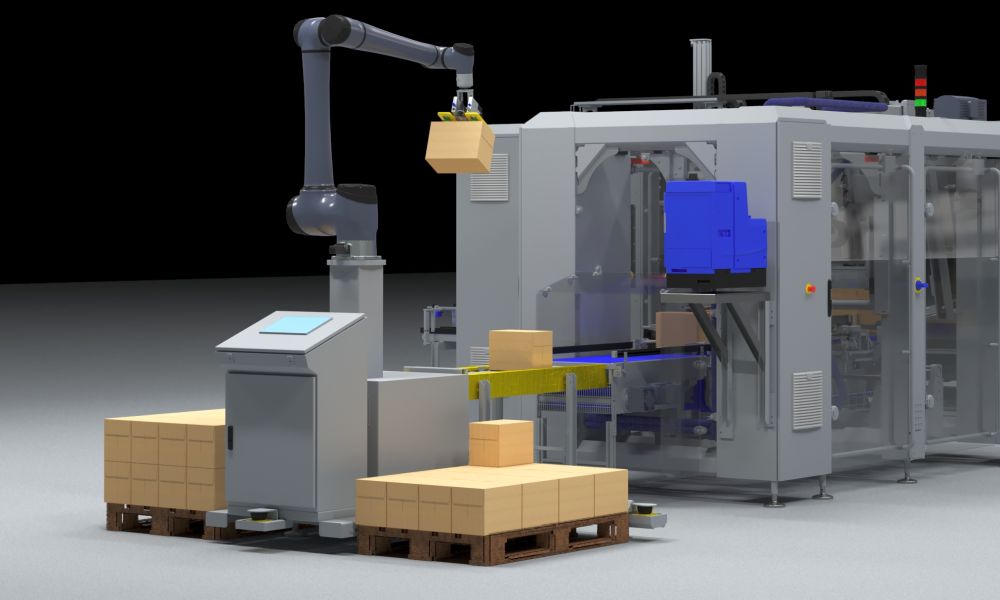
“Cama’s collaborative palletizer reduces repetitive tasks and keeps the production flow stable right up to the end-of-line by automating activities that are still performed manually. The collaborative applications of Cama’s Machine Enhancement Program (MEP) can be integrated into Cama automatic machines or added ex-post as retrofit solutions on existing lines,” began Lorenzo Birro, Key Account Manager at Cama.
What are the advantages of collaborative palletizer?
The collaborative palletizer reduces operational errors and personnel risks, helping make the end-of-line packaging flow more continuous and predictable. Its vision systems and safety cameras control the carton, the production recipe, and the correct orientation of materials in the machine magazine. They also check the language and the regulatory compliance of the packaging for the destination country. This helps prevent batch recalls, energy and material waste, and delays in delivery. Ergonomics improve substantially: when a cobot loads carton blanks into the carton magazine, an operator usually handles cartons from a pallet that does not exceed 1,450 mm in height. With the cobot, this height can exceed 1,700 mm, reducing the number of pallets that need to be moved and, as a result, lowering logistics costs and environmental impact.
Lorenzo Birro’s explanation was clear. “In collaborative applications, vision systems guide and control the entire process, from opening the American case to loading the cartons into the machine magazine. Pre-glued cartons shipped in American cases are first identified and verified. The system automatically cuts the cardboard, removes the lid, picks the cartons, and feeds the magazine. This eliminates the use of box cutters and manual tools that can be potentially dangerous. The cycle is complete and also includes separating the plastic from the paper-based packaging. Any plastic overwrap used for moisture protection or sanitization is removed and sorted into dedicated recycling containers. The result is a controlled collaborative process that reduces errors, increases operator safety, and ensures the continuous automatic feeding of the cartoner”.
Ergonomics, safety, and prevention with the Palletizer and its collaborative applications
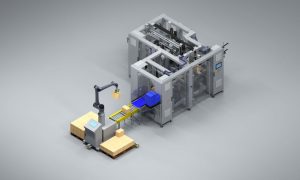
“Some examples of non-ergonomic daily tasks that can cause physical strain for operators include:
- Manually and repeatedly supplying a machine by lifting cases weighing up to 15 kg to a height of 1.5 m.
- Restocking the magazine of a case packer running at 15–25 cases per minute, with only 30 minutes of material autonomy.
- Continuously feeding cartoners that operate at up to 200 packs per minute and require uninterrupted loading.”
“Automating these activities with cobots reduces potential injuries and limits errors in the most repetitive and demanding operations. The collaborative palletizer stabilizes the workflow and frees personnel, who are increasingly difficult to find, from physically demanding, low-value-added tasks. This allows operators to focus on line monitoring, quality control, and the supervision of the entire process. To guarantee these results, we analyze and certify the safety of the entire work cycle: carton picking, the cobot’s trajectories and accelerations, and the protection systems, up to the final load release,” continued Lorenzo Birro. In fact, when a cobot lifts a ream or a case, the risk assessment must consider not only the dynamics of the arm but also the gripper and the edge of the carton, which may pose a hazard to the operator’s eyes and face. Operator protection is central. The evaluation of risk must therefore account for the arm’s movement, the gripper, and the carton edge, all of which can represent potential dangers for the eyes and face. Protecting people is the primary focus.
In the retrofit of existing lines, it is essential to verify the available space and to integrate the safety functions correctly to obtain a truly collaborative application. This allows the use of non-physical barriers, such as safety laser scanners that create a virtual ‘cage’ around the work area. If the solution is not collaborative, physical barriers are required, with an impact on the operating footprint, intralogistics, and evacuation routes. The cobot-based solutions of Cama’s Machine Enhancement Program are designed to operate close to people in compliance with ISO 10218-2 and with the technical specification ISO/TS 15066 on collaborative safety: certification must apply both to the robot and to the entire application.”
ISO 10218-2 – safe integration of cobots and collaborative applications.
The international standard ISO 10218-2 defines the safety requirements for integrating industrial robots and robot cells during the design, installation, operation, maintenance, and decommissioning phases. In the 2025 edition, the term “cobot” is replaced by “collaborative application” to describe more precisely the human–robot interaction. ISO 10218-2 applies to the integration of robots into machines, systems, and cells, with the goal of ensuring operator safety throughout the entire life cycle of the system.
ISO/TS 15066 – sharing the workspace between cobots, collaborative applications, and people.
The technical specification ISO/TS 15066:2016 details the safety rules for collaborative robots, in continuity with the ISO 10218 standards on industrial robots. It sets out the criteria for risk assessment and for the design of collaborative cells, defining the permissible contact limits on different areas of the body and distinguishing between quasi-static and dynamic contacts, with the aim of protecting the operator during human–robot interaction.
In the ISO 10218-2:2025 revision, these principles are incorporated into the requirements for integrating collaborative applications into machines, systems, and robotic cells. The scope includes all situations in which robots and operators share the workspace, ensuring operator protection throughout the entire life cycle of the system.
Software makes the difference in collaborative applications

“Manufacturers of collaborative robots work closely with Cama because the field of collaborative applications for packaging is developing rapidly, and software is the strategic element,” highlights Lorenzo Birro. “These solutions may appear simple, but they require accurate integration. Cama operates along two main lines.”
• In the case of a new Cama machine, the cobot is integrated as part of the machine. The customer benefits from a single Human Machine Interface (HMI), a unified set of components, one set of documentation, a consolidated spare parts platform, and a single safety certification with a risk assessment that covers the entire line, including the collaborative application. The entire system is managed directly from the HMI of the packaging machine.
• When a stand-alone application is developed, the same approach is replicated on a smaller scale within the collaborative cell. In terms of software, Cama works with the cobot partner to maintain a common thread with Cama machines, ensuring consistent support, commands, and language. Based on the solutions already installed at the customer’s site, the applications are developed in the same development environment and with the same control architecture, simplifying both local and remote support and reducing overall management complexity.
In collaborative applications, the cobot’s native software is used for safety, motion, and axis control functions, and programming is carried out in its natural environment without modifying the axis control of the other machines in the line. The customer is still provided with an interface that is consistent with what they are used to, ensuring that the collaborative system operates uniformly with the rest of the plant and remains aligned with the adopted brand strategy”.
Supply chain is expanding. Three-party design: end user, machine manufacturer, and material supplier
The collaborative packaging supply chain is growing and now includes material suppliers within the process. “Supply chain coordination takes place on two levels.
Upstream, shared standards are defined for pallet layout and for pallet characteristics such as tolerances, protection systems, controlled humidity, and carton flatness. This ensures that the material arrives compliant and ready for use on the packaging lines and at the end-of-line palletizing stage.
Downstream, during acceptance and before loading into the machine, Cama’s collaborative applications use artificial vision and automatic realignment systems to square the stacks and correct the deviations generated during transport. The system replicates the operator’s gestures in a controlled manner, making the process repeatable, traceable, and safe throughout the entire supply chain,” explains Birro.
“At interpack 2026 we will present an automatic device for loading cardboard onto pallets, designed to keep the quality of the carton blank flow to the packaging lines constant. Collaborative applications extend across the entire supply chain of packaging materials. With production rates so high, automating supply and machine feeding frees the operator from the most demanding and repetitive tasks.”
To achieve this result, materials and transport must be designed together: the pallet layout, the arrangement of the cartons, and the protections with barriers or shrink film are defined. Design therefore becomes a three-party agreement between the end user, the machine builder, and the material supplier, aimed at creating a regular robotic cycle that can be certified according to safety requirements while preserving the quality of the carton blanks throughout the entire supply chain.”
Cobots and AMRs: a mobile solution for smart intralogistics
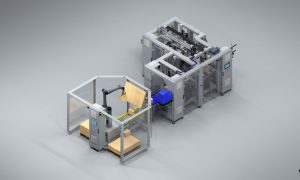
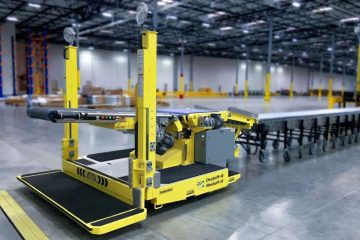
Cobots can be installed on board an AMR (Autonomous Mobile Robot), transforming the application from a fixed station into a mobile solution. A cobot–AMR system can serve multiple packaging lines: if the palletizer is stopped for maintenance, the unit can move to another line and, by changing the gripper, perform carton-loading operations or other machine magazine feeding tasks. In this way, a single mobile system ensures production continuity and greater flexibility in line feeding.
“We are talking about an intelligent alternative for plants with limited space. It improves accessibility to the packaging lines and does not constrain the production layout. The applications are numerous: for example, the cobot picks up the film reel, orients it, lifts it to the required height, and loads it onto the spindle of the flow-pack reel holder (the cylindrical shaft on which the film reel is mounted), serving two machines alternately with a single system. In this scenario, the operator keeps the role of line supervisor.”
The mobility of the AMR is constrained by operational safety. The system moves within a digital perimeter, with forbidden zones and authorized paths configured inside the plant. This reduces footprint and investment compared to multiple fixed cells while preserving high plant flexibility.
To correctly design these collaborative applications, it is necessary to verify cycle times, human–machine interactions, and safety systems. Only under these conditions is the application truly collaborative and not a traditional robotic cell. Cama supports the customer throughout the entire analysis, defining tasks, tooling, and operating perimeters for the safe and mobile use of the same system on multiple lines.”
The potential of the Cobot–AMR combination in intralogistics
The adoption of combined cobot–AMR systems is still in its early stages, but the potential is high. Today, the companies integrating cobots and AMRs for feeding packaging lines are pioneers, and double-digit growth of more than 20% is expected within the next two years. Many plants are already well automated at the level of the individual machine, but the intralogistic “glue” between lines and departments is still missing.
Cobot–AMR systems fill this gap: they reduce handling times, lower operating costs, and significantly improve operator ergonomics.
“Each application requires research and development work, including the analysis of the work cycle and its flows, the integration of vision systems, and the necessary customizations. Specialized teams design genuine human–machine collaboration. In the long term, Cama prioritizes brand coherence when the customer already has a ‘population’ of cobots supported by solid local technical assistance. A homogeneous machine fleet simplifies maintenance and spare parts management: avoiding too many brands reduces complexity and costs throughout the entire life of the plant,” explains Lorenzo Birro.
Cobots and AMRs today, humanoids tomorrow: the future of packaging
While we talk about cobots and AMRs, we are already considering humanoid robots, which are moving out of the “laboratory robot” phase and becoming potentially useful tools in industry, including packaging. Their human-like form allows them to move in the same environments as operators, occupy the same spaces, and work at the same operating heights. In many cases, they can use the same tools designed for people, without needing to redesign the packaging line from scratch.
Lorenzo Birro continues, explaining that “humanoids will complement cobots, traditional robots, and AMRs in situations that require greater variability of intervention: frequent format changes, end-of-line reconfiguration, the handling of non-standard products or packaging, and small internal logistics tasks between machines. They will not replace existing automation but will make it more flexible, taking over low-repeatability tasks that today still require a strong human presence.”
In the short term, humanoids will appear mainly in pilot projects, carrying out testing activities, light maintenance, material replenishment, and supporting operators on packaging lines. In the medium to long term, as costs, safety, and reliability improve, they may become an additional element of the factory ecosystem, where Cartesian robots, anthropomorphic robots, cobots, AMRs, and humanoids will work together. The goal is to make packaging more flexible and continuous while increasing the plant’s ability to adapt to market variations.”
Collaborative palletizer: flexibility, space saving, and energy saving
The collaborative palletizer is a compact solution designed to optimize the layout of the end-of-line palletizing area. On Cama machines, the space for the cobot is already provided; when integrated as a retrofit on existing plants, the unit retains its compact footprint and does not require large additional dedicated areas.
For example, in a dual-bay configuration (separate carton-feeding areas) with one pallet on the right and one on the left, the full pallet can be replaced with an empty one while the cobot continues working on the other bay. The changeover occurs without stopping production, making optimal use of the operating space and ensuring a more continuous and orderly end-of-line flow.
“The flexible layout of the palletizer allows several configurations. The unit can be positioned in line with the case packer or rotated by 90°, keeping aisles clear for forklifts and pallet trucks and improving the intralogistic flows within the department.”
“At interpack 2026 a solution for loading carton blanks will be presented, based on a compact device dedicated to the loading point. This reduces the area required around the feeding zone and shortens the material-serving path toward the machine. The result is an overall space saving of about 10–15%, with more linear flows, fewer interferences between people and vehicles, and a more orderly management of the production layout,” continues Lorenzo Birro.
“On the energy front, the contribution of collaborative applications in packaging is significant. A cobot has a lower mass than an anthropomorphic robot, uses smaller motors, and requires less energy to perform the same feeding or palletizing operations. In Cama’s collaborative applications, compressed-air circuits are often eliminated and replaced with electric or electronic actuators, which leads to a marked reduction in operating costs and losses.”
When the collaborative solution is integrated directly into a Cama machine, redundant components can be eliminated at the source: electrical panels become more compact, fewer devices are installed, and kilowatt-hour (kWh) consumption is reduced. Process quality also contributes to the overall energy balance: fewer errors mean no rework, less product and packaging waste, and therefore lower energy and material consumption on the packaging lines.
Monitoring systems on packaging lines now detect consumption per recipe and per batch. Process data analysis and artificial intelligence (AI) will allow increasingly precise optimization of utility usage for each operation. As a conservative estimate, an optimized collaborative solution can deliver about 25% energy savings compared to a robot with the same payload, considering the installed power. This is an evolving path, aimed at accurately measuring the energy consumption of each batch and supporting more efficient operational choices based on the information collected.
The combination of a reduced footprint, layout flexibility, and energy savings makes the collaborative palletizer a concrete ally for those who want more modern and safer packaging lines, competitive in cost and economically advantageous at the same time”.