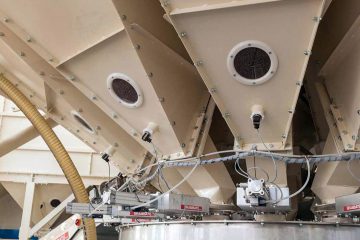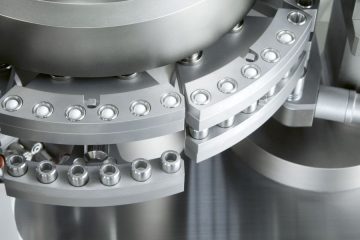

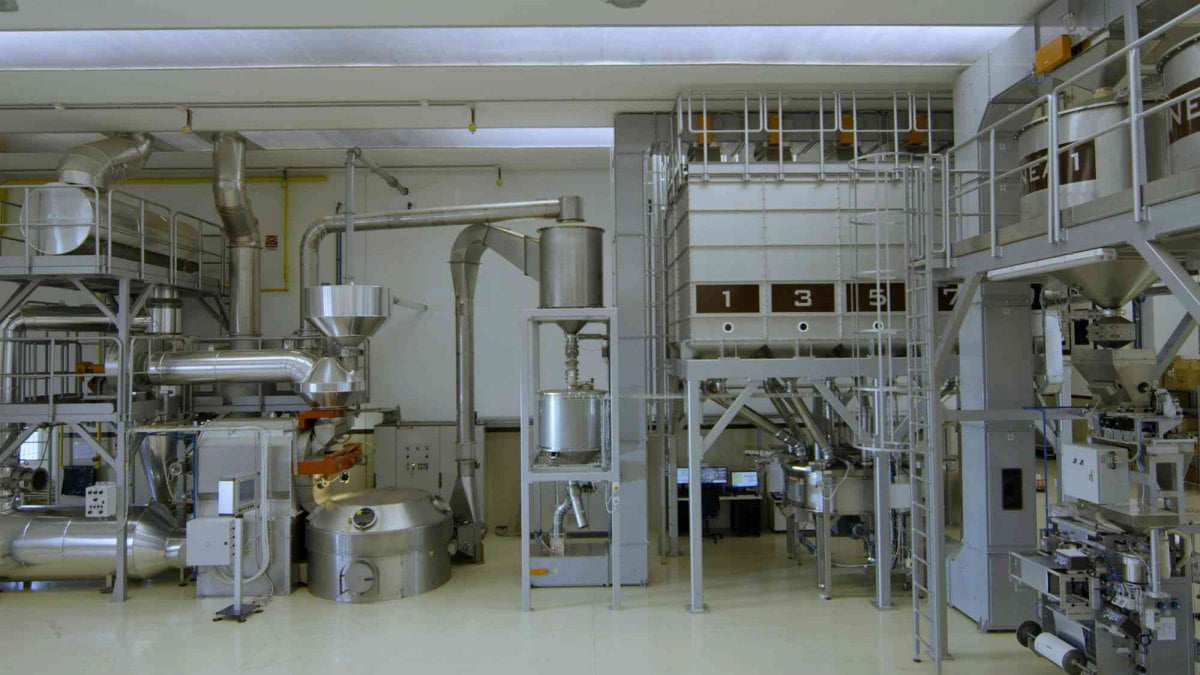
The Brambati’s Advanced Food Lab goal is to perform useful tests for R&D and to prototype machines and systems for the food industry, easy with the new software. (video: Brambati)
The Brambati’s Advanced Food Lab for drying, grinding, roasting, degassing and emission control. A rigorous scientific method to test the working processes of food products, thanks to an advanced automation system.
The laboratory Brambati (a company established and operating in Codevilla, near Voghera, in the field of machines for the food industry since 1945) has opened after two years of work shows that it is possible to implement innovation and latest-generation technologies in the food industry too, even though this is one of the most traditional sectors in the Italian economy.
The facility is unique in Italy and one of the first ones in Europe. Practically, the Advanced Food Lab (AFL), now occupying a wing in the Codevilla plant, operates on food products subject to various processes such as drying, grinding, roasting, degassing and emission control, which are all managed by an advanced automated system.
“The idea came mainly to guarantee a higher scientific imprint for production processes, which only a pilot plant reproducing the process of an industrial facility may allow. It is not only important to guarantee the result, however to guarantee the scientific imprint and how this is attained. That is possible thanks to a technologically very well equipped lab,” explains the chair of the group, Fabrizio Brambati.
The goal of the Brambati’s Advanced Food Lab is the preventive tests on machinery as requested by customers
The Brambati’s Advanced Food Lab goal is to perform useful tests for R&D and to prototype machines and systems for the food industry. Moreover, the facility may perform preventive tests on the machinery as requested by the customers, thus making servicing easier thanks to an integrated product and process control.
The total investment was made thanks to a contribution by the Lombardy Region, as part of the Competitiveness Agreements (referred to the years required to develop and realize the project). This is a new program aiming at supporting innovative enterprises, co-financing research and development projects on condition that the fund-benefitting companies guarantee that production and investments remain on the territory.
Important investment in R&D to be a reference point for the industry

For the group founded by Francesco Brambati in 1945 in the sector of wheat mills and now in the hands of the family’s third generation, this is a new step ahead towards innovation, which the company keeps striving to. The average investment in R&D ranges between 3 and 5% of the total turnover, which is a considerable amount for a country like Italy where investments in this field account for less than 1.5% of the GDP.
If Brambati aims at using the Advanced Food Lab to experiment and develop new processes in house on one side, on the other the facility aims to establish a reference point in Codevilla for the industrial sector. The lab, in fact, will be open to Brambati customers too, who will be able to test their products here: not only the local companies, but also multinationals looking for advanced services in the area of Voghera.
New processes, technologies and testing with the Advanced Food Lab
“The AFL shall address the internal R&D team for new processes and technologies and for testing purposes – adds Fabrizio Brambati – and the customers as well to guarantee control and analysis services using their product, with the help of Brambati experts who are available with all the latest generation instruments inside the lab. Actually, in fact, the Food Lab shall not be installed at the customers’ premises. In addition, it will be available for schools and universities for exemplification and as a cultural and information centre on food processes and products”. Actually, the AFL will be open to students too, to let them “understand the process issues and develop new ones, thus enabling “young” ideas to be shaped and to be possibly used,” explained the chair.
From the design phase with Industry 4.0: efficiency and sustainability

The establishment of an ecosystem between large companies and research and training groups is part of a strategy striving to maximize the lab investment.
The interaction between manufacturers of machines for the food industry, customers and researchers will allow not only performing lab tests and analyses (physical, chemical and organoleptic ones on the raw materials and the processed foods), but also searching for optimal customized technological solutions.
Here, the future of the Italian industry comes in: the Industry 4.0 paradigm that, thanks to flexible and adaptive automation systems, will allow searching for optimal processing parameters and customizing the process based on the customers’ needs.
In fact, Brambati will use cutting-edge technologies since the design phases (3D scanner, dedicated graphic software…) to offer the customised solutions that are most appropriate for the custom’s needs. Actually, the Advanced Food Lab software aims at managing and capitalising on the information that shall be generated within the field of the Food Lab activities starting from the customer’s specifications.
Tests and theory but confronted with practice, confirmed by the lab analyses
Moreover, the software will generate a Customer Report for each job: it is a document to collect information on the processing cycles and the single tests performed.
“The Advanced Food Lab is the logic consequence of Brambati’s policy to pursue continuous innovation research, where tests and theory are not enough. You need confrontation with practice, possibly confirmed by the lab analyses and the certifications by accredited entities and universities – adds the chair. – This shall not change our company’s philosophy that is continuous striving towards turn-key solutions, environmental sustainability, the workers’ safety, the guarantee of a constant and clearly customized product as all customers want it to be”.
The potentialities of AFL: replicating at an industrial level the coffee roasting

The outcome of the optimised processing processes is enhanced processing efficiency and a reduction in emissions and in energy consumption too.
To understand the potentialities of AFL better, it is important to consider coffee roasting: an art that process and product engineering allows replicating at an industrial level.
The company in Voghera, however, has been leader in this sector for years now and it offers turnkey plants, from the reception of green coffee grains to the production of the roasted product.
The roasting process: thermal process to develope the flavours and aromas of coffee
During roasting, the grains of green coffee are submitted to a thermal process, which changes them at physical and chemical level, developing the typical flavours and aromas of coffee. By optimizing the thermo-dynamic roasting of coffee and checking specifically the variables at stake, it is possible to customize the taste of all kinds of coffee pursuant to the customer’s requirements.
“The Food Lab will allow the single coffee producers to optimise and obtain the best from their product, by performing small repeated productions until they reach the desired result. Once the right recipe is found, this will be replicated at the final customer’s,” explains Brambati.
Francesco Brambati Costruzioni Meccaniche: the continuous innovation started in 1928

For a group established in the sector of wheat mills, currently ranking among the main European and world operators in the segments of the pastry industry, bread-making technologies, baby-food or coffee processing (by extending the own activity to plants for the chemical and pharma sectors too), the Brambati’s Advanced Food Lab shall not be the final innovation.
In fact, Brambati has entered very competitive sectors controlled by companies boasting centuries-long background and has thus turned innovation into a strong point of the own corporate policy to conquer market share.
Today, the spirit you feel in Codevilla is still that, which animated its founder: the man with an extensive technical culture and rich sensitivity who, after starting the design of mill machinery in 1928 and enhancing several companies in the field, started his own business after the War, “Francesco Brambati Costruzioni Meccaniche”, today simply Brambati Spa.
His heirs’ idea is that, since the beginning, the group will start working on other innovations, aiming not only at keeping production control and employment in the historical seat in Codevilla, but also at pursuing growth with new recruitments and an eye on the foreign markets.
“Brambati’s key to success has always been its ability to look ahead, anticipating times, offering innovative machinery and services that could not be found on the market, and being flexible when meeting the customers’ special requirements – concludes the company chair. – Of course, time runs and we will thus further focus on R&D. We will further innovate and invest on it, because we want to be always a step ahead in a more and more competitive market”.
Brambati and the new software: unique environment to analyze all aspects of roasting
The most significant advantages of the new software solution are two:
• increasingly marked flexibility;
• ease of use.

The new software allows to optimize the performance of the roaster both for customers who need more in terms of production (toasting stability, repeatability of results and process speed), and for those who want to experiment with new ways and new roasting profiles.
The new software gives the possibility to do all this by offering different roasting methods and providing all the tools necessary for analyzing the results obtained.
The idea that led to the implementation of this software was to provide customers with a unique environment of use in which it is possible to analyze and correlate all the main aspects of the roasting and therefore allow the user to maximize the yield of the system.
High production performances: recipes management and repeatability of roasting process
The software improves the connection between the production needs and the requirements of the specialties coffee applications.
Always keeping the features indispensable to guarantee a high production performance, like the recipes management and the repeatability of the roasting process, the new software allows the users to overlap historical curves during the roasting phase, to appreciate, in real time, the discrepancies and verify variations or any drifts.

Furthermore, it is possible to add characteristic points during the roasting phase like
• yellow point;
• crack 1–2;
• cinnamon point.
Or custom comments and later to compare all obtained curves, to analyze the differences in terms of temperatures, rate of rise and all other process values.
Web application for the phase of cupping to evaluate the coffee flavor
Very important phase is the cupping, where different users can evaluate together the coffee flavor, creating their own evaluation sheets and giving their personal comments. To do this, Brambati developed a dedicated web application where it is possible to access with any kind of device (PC tablet, mobile etc.). In the same application, it is possible to see the historical roasted curves, the green coffee usage, the previous cupping sessions and the KPI of the roaster, such as the number of batches done, the recipes used, the frequencies of alarms, the productivity and much more.
More info about:
Brambati
Did you get here?
Maybe you are also interested in:
Coffee and Tea