
In today’s market, Vitamin C is available in several pharmaceutical forms, including capsules, tablets, chewable tablets, effervescent tablets and granules. Among these, capsules and tablets are the most common, as they allow for a more accurate and precise dosage of the product to be taken.
Compared to other dosage forms, capsules ensure rapid release and provide effective protection of ascorbic acid (the chemical name of Vitamin C) from humidity, heat and oxidation, preserving its physicochemical properties and long term stability. Capsules are also perceived by consumers as a high quality dosage form, partly because they often contain “purer” formulations, free from sugars, colourants or other excipients typically used in chewable or effervescent forms. Even high dose products commonly available on the market (500–1000 mg) remain easy to take thanks to the ergonomic shape of the capsule.
In this article, a pure Vitamin C powder formulation is evaluated. The capsule filling technology developed by IMA is examined together with the specific machine adjustments applied to achieve optimal process stability.
The challenge of Vitamin C
The daily challenge for nutraceutical manufacturers involves processing Vitamin C efficiently, maximising productivity without compromising the quality of the final product. Crystalline Vitamin C presents several technological characteristics that affect its processability on automatic capsule filling machines. The main critical aspects to consider are the following:
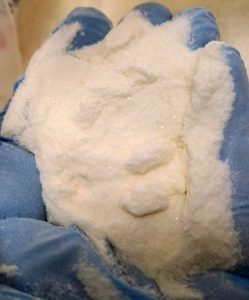
- Crystalline Vitamin C tends to form agglomerates and lumps. (photo: IMA)
High-dosage levels required by the market
The nutraceutical market often demands high fill-weight capsules with high Vitamin C content, typically between 500 and 1000 mg per capsule, or even more.
Achieving these fill weights requires specific process optimisations aimed at densifying and compacting the powder. However, increasing compaction forces also increase the temperature during the process, further intensifying the natural tendency of Vitamin C to adhere to metal contact parts.
Tendency to adhere to metal parts
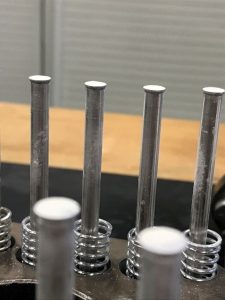
Vitamin C presents a strong tendency to adhere to the metal parts involved in the capsule filling process. Non uniform adhesion can affect the amount of powder transferred into the capsule, resulting in weight variability during production.
This effect becomes more pronounced as temperature increases, to which Vitamin C is highly sensitive. To identify the right balance between the high fill weight required and its sensitivity to temperature, it is necessary to apply technologies that increase powder density without applying excessive compaction forces.
High hygroscopicity
Vitamin C rapidly absorbs moisture from the environment.
Moisture can cause lumping or agglomeration, leading to reduced powder flowability and negatively influencing powder behaviour both during bowl feeding and in the dosing phase.
It is therefore essential to consider not only the machine operating conditions, but also to take into account the storage, transport and handling of the raw material and mixtures.
Formulation and technological analysis
A pure formulation composed exclusively of crystalline L-Ascorbic Acid, with no excipients present, was investigated. The pure product typically represents the most challenging process scenario compared to formulations containing excipients.
Technological analysis of pure Vitamin C formulation was carried out in the IMA Active Competence Center laboratory. The purpose of this evaluation was to predict and optimise the processability of the powder on automatic alternating motion capsule fillers.
Table 1 summarises the main technological parameters evaluated during the analysis: bulk and tapped density also used for calculating the Carr Index and providing an indication of flowability; particle size distribution – PSD, measured using a sieving method; residual moisture content (loss on drying – L.O.D.) determined using a moisture analyser.
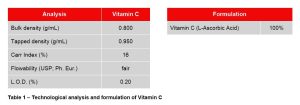
The pure Vitamin C powder is characterised by relatively low bulk density and a significant difference between bulk and tapped density. This density profile explains the difficulty in achieving high target fill weight without increasing compaction force and promoting powder densification.
The formulation presents a Carr Index of approximately 16; according to the classification reported by the United States Pharmacopeia (USP) and the European Pharmacopoeia (Ph. Eur.), this value corresponds to a “fair” level of flowability.
Moisture values (L.O.D.) are very low; however, pure Vitamin C shows a high tendency to adsorb moisture when exposed to ambient conditions.
For this reason, during the analysis and machine trial, particular attention was paid to the storage, handling and preparation of the test material. Furthermore, the capsule-filling test was carried out under controlled and stable environmental conditions, with constant temperature and relative humidity.
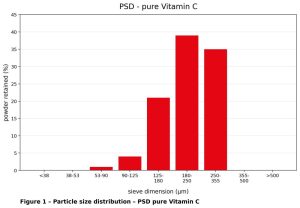
Figure 1 shows the particle size distribution of the pure Vitamin C formulation. The powder exhibits a unimodal profile, characterised by a predominant particle fraction between 125 and 355 μm.
Machine parameters and recommended process optimisations
Table 2 provides an overview of the main machine parameters used to process pure Vitamin C.
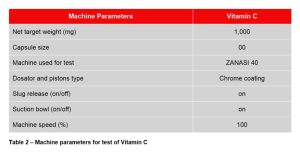
The test was performed on a medium speed alternating motion ZANASI series capsule filler at maximum production speed.
The powder shows a tendency to agglomerate; therefore, before loading it into the machine, it was necessary to break up the agglomerates formed during storage and transport.

For this formulation, the use of dosators and pistons with hard chrome surface coating and the slug release function was necessary. Despite these mechanical features, the powder still tended to adhere to the piston head, forming a thin, stable layer that remained constant throughout the process.
To achieve the target net weight of 1,000 mg, the suction bowl was activated.
The suction level was set very low to increase powder density without excessively compacting the product.
The suction bowl not only enabled the target fill weight to be achieved, but also limited the slug size, allowing proper capsule closure according to the capsule supplier’s specifications.
The weights of the filled capsules are within the tolerances required by the customer. The low relative standard deviation (RSD) values obtained from the sampling performed during the trial (≤ 1.5%) indicate a stable and repeatable process.
Below is a description of the features used during the test and their respective functions:
- Dosator and piston with hard chrome surface coating:
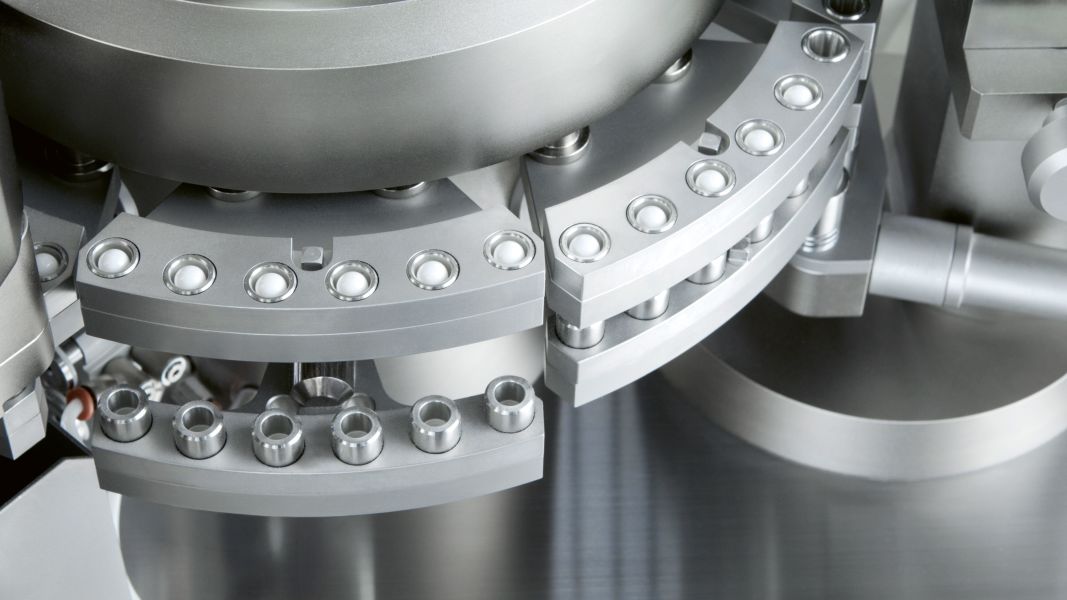
Powder dosing technology on IMA capsule fillers relies on the use of dosators and pistons (syringe type dosing). This volumetric dosing method works through the formation of a powder slug.
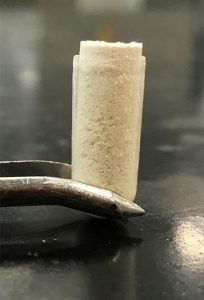
The piston moves within the dosator, creating a dosing chamber. The powder is collected inside this dosing volume during penetration of the dosators into the bowl. Slug formation occurs through powder compaction generated both by the penetration of the dosators into the powder bed and by the movement of the piston within the dosator.
Standard product contact metal parts are made of stainless-steel material. However, when working with powders that tend to adhere to metal parts, specific dosators and pistons with a hard chrome surface coating are recommended. This treatment significantly reduces powder adhesion.
- Slug release:
The slug release mechanism actuates a horizontal sliding movement of the capsule body support element during the slug ejection phase. This motion assists slug release by detaching it from the piston head.
The function is particularly recommended for adhesive powders that tend to stick to the piston head. If the slug — or part of it — remains attached and is not expelled correctly, it is sheared off when the slug release mechanism shifts horizontally. The use of the slug release system ensures correct powder dosing within the capsule body and enables proper capsule closure.
- Suction bowl:
The suction bowl allows the extraction of inter-particle air present in the powder inside it, leading to a significant increase in density. This greater density corresponds to a larger amount of product that can be dosed into the capsule.
Airflow moves from top to bottom, passing through a circular filtered opening located at the bottom of the bowl. A calibrated mesh positioned above this opening allows air to pass through while retaining the powder particles.
Implications of powder adhesion in the dosing chamber
Adhesion of Vitamin C powder to the metal parts of the dosing chamber represents a critical challenge in the capsule-filling process. This behaviour can lead to two distinct scenarios:
1) Non-uniform adhesion to metal parts.
When the powder adheres irregularly to the metal parts of the dosing chamber, variations in the effective dosing volume arise between the different dosator–piston pairs.
This leads to the formation of powder slugs with inconsistent volume and weight. This is the most critical scenario, as the instability persists throughout the production run.
2) Uniform adhesion to metal parts, after an initial phase.
The powder adheres uniformly to the metal parts of the dosing chamber. After an initial adaptation phase, the weights are consistent allowing the process to remain stable and repeatable over time.
High compaction forces needed for the high fill weight required and environmental conditions might generate heat which increases the tendency of powders to adhere to metal parts.
Limiting adhesion is essential to minimise these scenarios. Two complementary approaches are recommended:
a) Mechanical solution: use of dosators and pistons with special surface coating, along with the slug release function.
b) Process related solution: reduce compaction forces and maintain controlled environmental conditions (temperature and relative humidity).
The suction bowl increases densification of the powder in the dosing tank. However, higher density results in stronger internal forces, which in turn raise temperature and increase powder adhesion to metal parts.
The suction bowl is recommended as a technical compromise when higher densification is required to reach the customer’s target fill weight, such as in the case of Vitamin C.
Conclusion
The trial performed with pure Vitamin C demonstrates that the flexibility of IMA capsule fillers makes it possible to achieve high fill weight of the pure product, without excipients, with stable and repeatable results, even when processing powder with challenging properties.
The optimisations described in this article — in particular the use of hard chrome coated dosators and pistons and the slug release function — proved essential for reducing powder adhesion to metal parts and ensuring more consistent dosing performance.
In addition, the controlled use of the suction bowl enabled the densification of the powder and the achievement of the high fill weights required during the trials.
With extensive experience in capsule filling technology and the continuous feedback received from many thousand customers who rely on IMA solutions every day, the company can offer reliable and repeatable processes even for technologically demanding products such as Vitamin C. This ensures process stability, dosing accuracy and continuous production performance.