

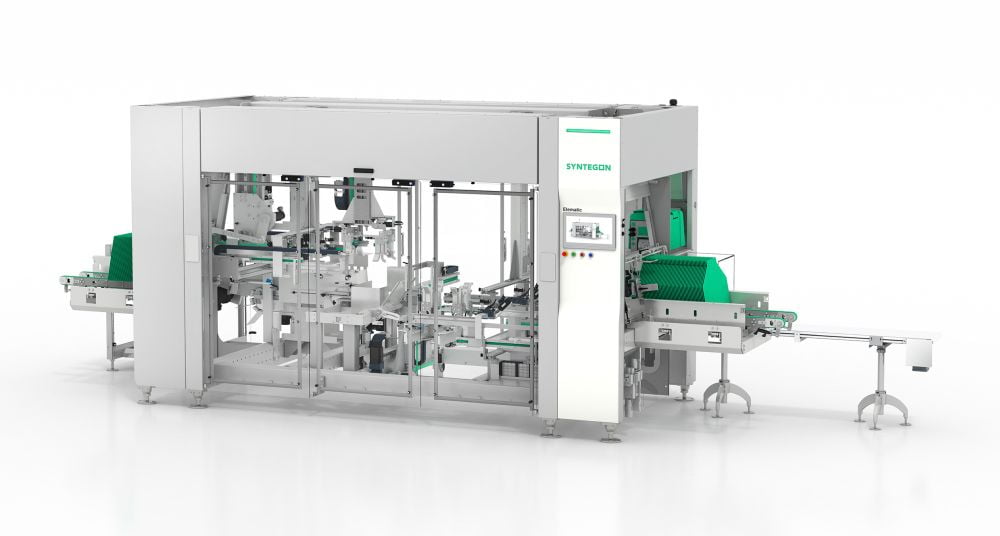

“Syntegon focuses on industries such as bakery, with cookies experiencing rapid growth in horizontal packaging. Plants for chocolate and bars, crackers, confectionery, cereals, coffee and tea, dairy, and fresh food are all manufactured by us. Our machines package frozen food and chips, but also candies, pasta, rice and noodles, pet food, powders, and snacks, using vertical packaging. This is to demonstrate the wide range of the Syntegon proposal for the food industry. Syntegon deals with primary and secondary packaging for these sectors, and with the production process for selected areas such as confectionery,” starts Johan Nilsson.
Maintenance is involved in the management of manufacturing plants
Production facilities, including those used in processing and packaging, bring up one of the topics we talk about daily: the cost of energy. Large factories must prioritize efficiency to provide customers with high-quality goods at competitive costs while conserving limited resources.
“Compared to the pharmaceutical industry, where developing new drugs is an expensive process with significant operational costs, the food industry is more cost competitive. Effective automated production is necessary to be competitive, and the line performances are crucial. Preventive maintenance will bring less downtime, more productivity, and lower production costs for business“.
Overcapacity or not? How to handle failures in production

Because mass food production must feed millions of families, large plants are producing continuously. How can humans eliminate a production slowdown? Overproduction or problem prevention?
“Excess production capacity is unwanted in the supply chain because it is extremely expensive. Manufacturers are much more involved than in the past with lowering plant failures. Limiting overproduction is a good starting point in a modern factory. This allows you to produce exactly what you require “, explains Johan Nilsson.
“Overproduction is sometimes used because, in general, condition monitoring is not observed. Instead, events may occur that suddenly interrupt production. The hourly costs of unexpected failure differ by sector, and this value is critical. The cost of unpredictability in the food industry is much higher today than it was ten years ago. We must be willing to invest in technology and maintenance. All maintenance offers to customers are divided into two categories: customers with capacity constraints and customers without capacity constraints.
With capacity constraints, customers are willing to spend a little more on maintenance to guarantee fewer unexpected failures. A customer with no capacity constraints may have low maintenance costs and be able to afford an unexpected failure due to overcapacity.”
How significant is the data?
Data management is crucial for a production plant to operate more efficiently, from collection methods to storage and processing of the data. “Without the data, it is difficult to predict a failure. It may take thousands of hours or just a few hours, depending on an infinite number of factors. It may be influenced by the environment’s temperature, the product being produced, the location of the machinery, or even the kind of machine itself. In conclusion, it is particularly challenging to foresee what might occur over an extended period, but in these circumstances, accurate data analysis is essential”.
What is Syntegon’s digital solution philosophy?
“It is clearly linked to what we are discussing. The digital aspect begins by displaying the data that is already known. If you ask factory managers of a food packaging company on the plant’s performance the previous week, some would find it difficult to tell. By collecting information, you can determine whether last week’s performance was better or worse than the prior period. This awareness of performance is important. Take waste as an example. By gathering data, you may examine it to comprehend how waste affects productivity and how you can improve it. This is our basic offer” explains Mr. Nilsson.
“From this point, you can improve the factory’s performance. You can use condition monitoring with the right algorithms to predict failures. You can predict failures with many devices based on the data. With such a predictive model, we can notify the customer and replace the faulty part before it fails and abruptly stops production. So that’s the idea behind it. We take this extremely seriously.”
Technology makes the difference between yesterday and today
“Previously, there was nothing, data was not used, and every plant shutdown was a big problem. Today, we are gathering data from machines to store it and create a historical database for future production. When a customer in any country has a problem, we try to find out what went wrong so that we can solve it as soon as possible. Today, virtual technology helps us; it is simple to intervene using system data, photos, and videos while located e.g. in Germany, Switzerland, or Italy. A simple intervention on the production equipment can be performed remotely, solving problems quickly. If we couldn’t do it remotely, we would have to consider relocating, wasting time and money.“
What challenges does the industry face in the future?

Among the most interesting challenges are language comprehension and the application of specific skills. In the first case, solutions are being developed; in the second, they are already on the market, such as those presented by Syntegon at Achema (the Service Agreements, ed).
“Language comprehension, particularly simultaneous translation, is one of the challenges of the future. We’ll be able to communicate in our native tongues—you in Italian, and I in Swedish—while completely understanding one another. We are addressing this issue and are close to finding an effective solution. The speed of translation—which is currently expensive but will soon enable us to connect people in new directions with incredible benefits in the industry makes the difference.
The integration of expertise is another challenge in addition to language. To solve a problem, you must first comprehend it, and in order to achieve this, you must transfer to your clients’ certain services and capabilities that will help them recognize their issues and provide quick solutions. I would like to highlight our Service Agreements, which comply to our customer-focused culture, as one of the solutions offered at Achema”.
Service Agreements: seven skill and service levels
Syntegon offers inspection, maintenance, spare parts management, and training services. “The Service Agreements, which allow customers to choose from seven different package options at a fixed price, is the main novel concept. Customers receive support at each service level, from basic service, which includes inspection and remote service, to guaranteed production performance for their machines. Customers can choose which level best meets their specific needs to meet maintenance targets based on their maintenance strategy. Service agreements provide much more than fixed and predefined prices: regular maintenance performed by service technicians reduces the risk of unscheduled downtimes and can even help avoid complete shutdowns.”
According to Johan Nilsson, “our customers benefit from a readily available service that ensures the long-term productivity, safety, and sustainability of their processes — while meeting their respective production and plant requirements.”
These agreements assist customers in lowering production risks, gaining predictive ability over service costs, and simplifying complex processes, allowing them to focus on their core business. It facilitates operations such as ordering spare parts and when a technician is required: having a factory manager on-site could be useful in cases of downtime, as he could intervene quickly and restart production in a short amount of time.
“Versatile service packages deliver maximum flexibility with minimal time investment and risk,” Nilsson says. “Instead of selecting individual services for their needs one by one, customers now receive exactly the products and services they require.”
A machine that is efficient is also sustainable
Nilsson emphasizes the significance of sustainability in manufacturing facilities, saying that “if you use an asset to create 10 or 15 million chocolate bars, the energy consumption is not proportional. Efficient production management benefits the environment, lowers costs per unit produced, and enhances consumer perception of the consumer products. To reduce energy consumption and other production parameters, we must recognize how crucial system efficiency is. My experience has shown me that a plant’s good utilization benefits the environment; customers have often found it difficult to comprehend this idea, but lately there has been a significant increase in customer sensitivity to these issues”.