The benefits of packaging simulation: it all started with Industry 4.0
Industry 4.0 is a concept coined in Germany a few years ago. It is the process of integrating factory automation systems with communication and information systems in order to increase plant productivity and product quality.
by Industrial Meeting
What can Industry 4.0 do for your customers? (video: Cama)
The transition from Industry 4.0 to the concept of “smart factory” is short. The smart organization is made up of three components:
• Smart production (new innovative technologies for production: collaboration between operators, machines, and systems);
• Smart services (“information infrastructures” and techniques: integration of systems and companies);
• Smart Energy (attention to engineering more performing systems by reducing energy waste).
This recent manufacturing approach is also known as the fourth industrial revolution. It is based on the use of techniques such as information technology (IT) (archiving, transmission, and data processing) and operational technology (OT) (management and control of existing physical devices operating in the physical world). To achieve convergence between information and operational technologies (IT) (OT).
“CAMA’s attention has been focused above all on operational technologies (OT),” says Filippo Aspesi, Cama’s Software Automation Manager.
• Advanced manufacturing systems: interconnected and modular, allowing for easy and efficient machine integration; • Augmented reality: this refers to vision systems that use augmented reality to better assist operators through everyday or maintenance tasks; • Simulations of mechatronic systems: amongst networked machines to optimize processes even before they are manufactured; • Horizontal and vertical integration: this refers to the sharing of a system’s available data between interconnected machines and vertically to company information systems. The use of these technologies has led to the reduction in time to market and costs of customizing the offer, as well as increased efficiency and access to information about manufacturing processes. OT technologies, on which CAMA has focused, allow for rapid remodeling and re-engineering of machines in a very short time, compensating for the shortage of components on the market, even in current period when the world market is suffering in the supply chain of electronic products.”
A good partner to take the first steps with Industry 4.0
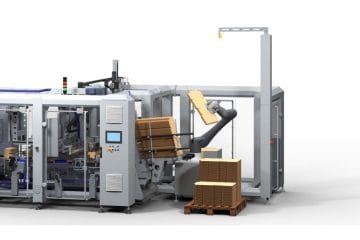
Cama uses simulation systems to build plants from the initial concept as well as to update those that require it. (photo: Cama)
“When we talk about Industry 4.0 applied to our secondary packaging systems, choosing the right technological partner becomes a priority for achieving precise planned objectives,” Filippo Aspesi continues. “When interfacing systems, augmented reality, and data management systems are introduced, the use of these technologies may appear disarming at first. To understand how it works, examples of concrete applications are required, ranging from the necessary investment to the long-term benefits “.
The value of simulation in manufacturing systems for the packaging industry
Massimo Monguzzi, Cama’s Research and Development Manager. (photo: Cama)
“Cama uses simulation systems to build plants from the initial concept as well as to update those that require it. The design of a plant requires simulation prior to implementation, which provides a significant additional value to the consumer. All of this, in reality, helps in saving money on future adjustments and time to market. Choosing one technology over another could be a costly mistake if you don’t use simulation in your design. Cama’s preventive feasibility study is highly trustworthy, as it reduces risks and predicts potential issues by resolving them. The simulation makes more sense the more interactions between different machines there are, thus preventive simulation is strongly advised in this instance,” says Massimo Monguzzi, Cama’s Research and Development Manager.
What is a Digital Twin, and how does it work? The simulation on the machine
Simulation is a cutting-edge techniques that is being increasingly widely used across several industries. (photo: Cama)
During the Ipack Ima 2022 fair, Cama presented a solution using the Digital Twin application. It’s a cutting-edge simulation system that replicates machine behavior in the manufacturing process even when other systems aren’t available.
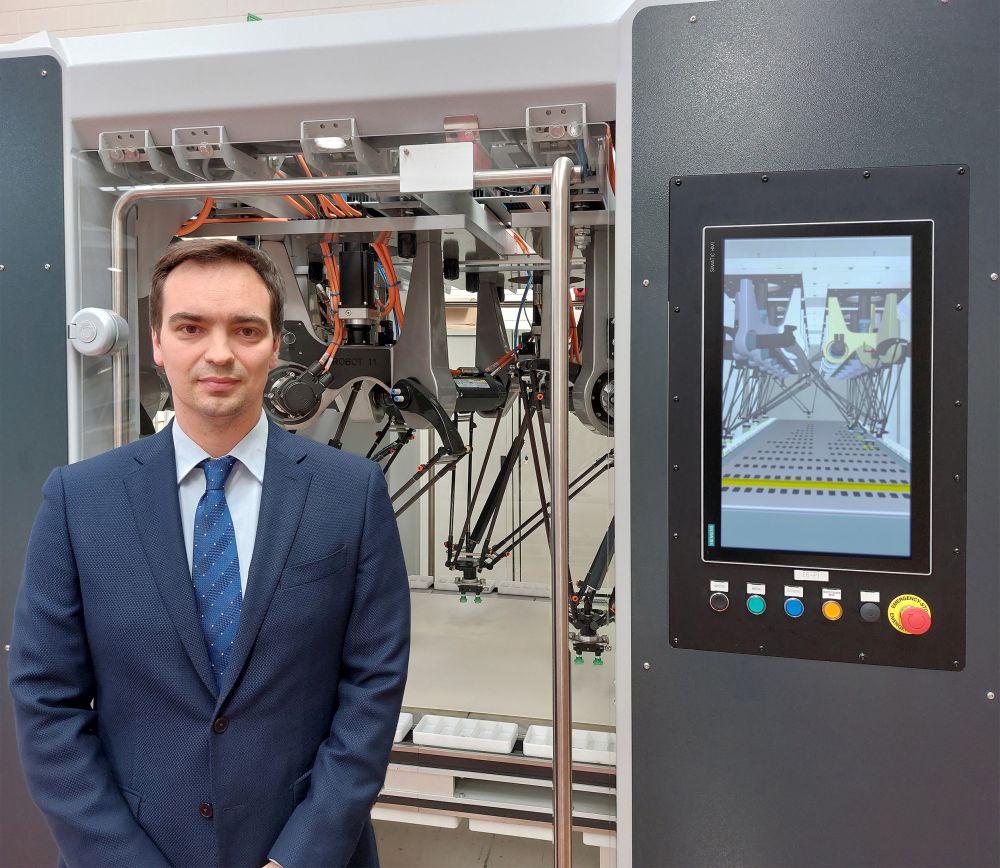
“Creating the Digital Twin was a significant investment that best helps clients by simulating the operation of their manufacturing machines before they are built.” According to Annalisa Bellante, Vice President of the Cama Group, “manufacturing processes are optimized in this way, revealing any limits before going on to the production phase, decreasing time to market.” The machine has a large HMI touch screen panel, which is especially useful when used with the Digital Twin. “Frozen product industries, for example, must process tons of product quickly and cannot test the entire production due to the need to maintain the cold chain. In such cases, it is critical to have an always-on simulation system of the entire production cycle on the machine. The simulation enabled us to rationalize the layout of the manufacturing plants, as evidenced by numerous successful examples, beginning with the reduction of the footprint for very large production systems” Massimo Monguzzi explains. “The simulation provides as both a design and a demonstration tool. This enables you to enter the minds of non-technical people who want to know what their system will look like before it is built: this is crucial.” Simulation is one of those cutting-edge techniques that is being increasingly widely used across numerous industries. A company with an existing factory that wishes to redesign it for increased production efficiency should simulate the project to understand the benefits and drawbacks before it is implemented.
Customer care: simulation and assistance in close cooperation
The transition from Industry 4.0 to the concept of “smart factory” is short. (photo: Cama)
“Within the commercial department, we support customers through the system engineering division, which intervenes in feasibility studies and complex system design.” By anticipating the final project, the simulation avoids any problems.
Annalisa Bellante, Vice President of the Cama Group. (photo: Cama)
“In this way, we have several advantages before the realization of the final plant: it improves the overall project of the machine and informs the customer about what the result will be,” says Annalisa Bellante, Vice President of the Cama Group, who continues, “another great and very important advantage during the pandemic was the ability to work despite of travel restrictions. In fact, the Digital Twin reduces human mobility by allowing remote work on the program, its development, and tests. With the simulation, we can predict exactly what the final plant will look like. Last but not least, customers receive assistance during machine installation. We were able to complete complex installations using these technological support tools without sending technicians, but rather working in close collaboration with the customers’ technicians, with great satisfaction for the results obtained.”