

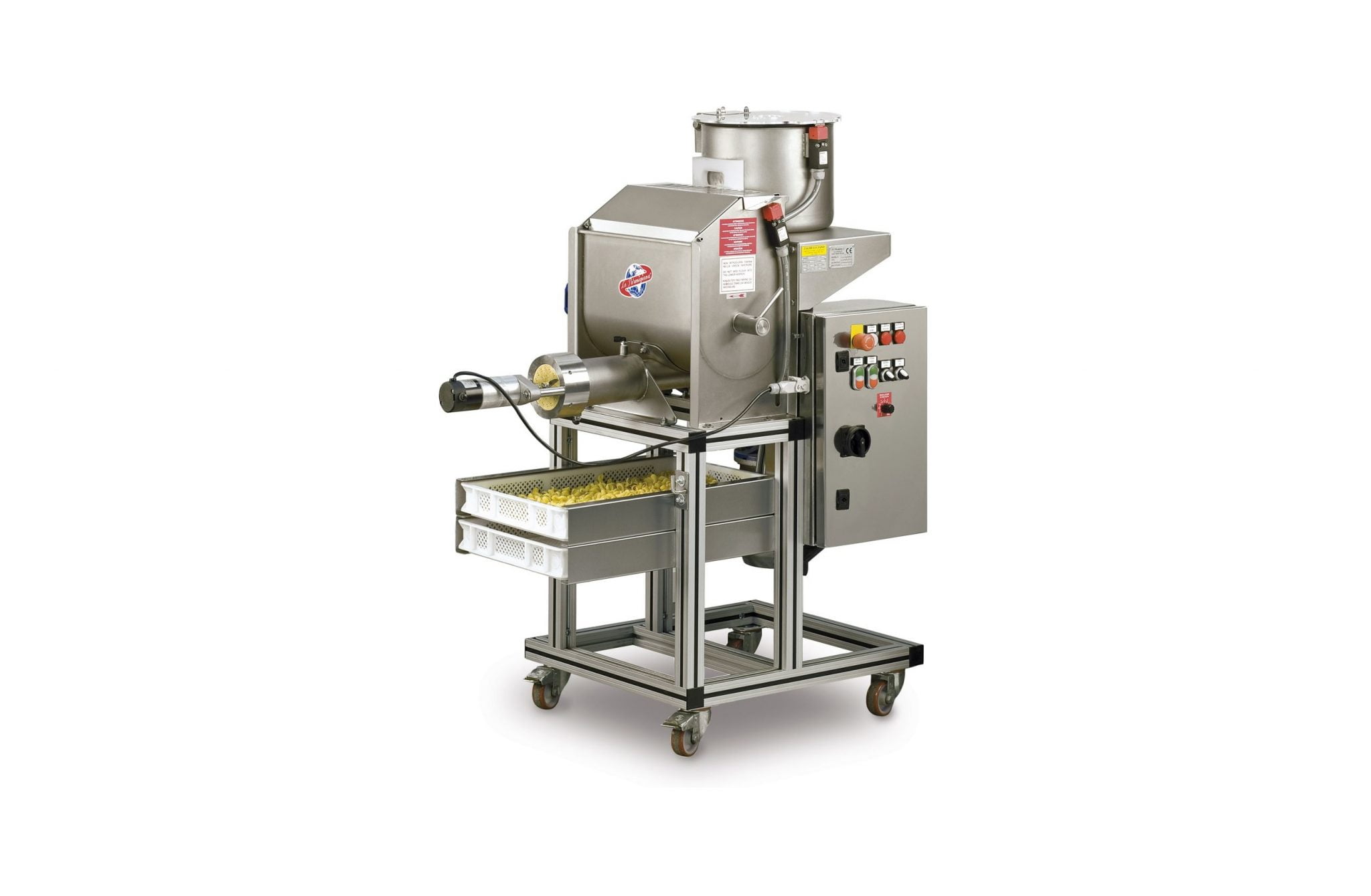
In the video a sample of the machine SG30.
(video: La Parmigiana)
The idea of designers was to apply all the regulations to make the machine certifiable, but also to follow parameters and guidelines relating to production quality, energy efficiency and ease of cleaning while reducing maintenance to a minimum (of the many present in the D55DV, only one bearing remains in the thrust bearing unit. No more bearings and bushings requiring greasing).
However, it was a question of providing continuity with the past, so that customers who wanted to replace the old machine with the new one would not suffer an excessive shock due to the change in volumes and production parameters.
Quality in pasta production of pasta, energy efficiency and easy cleaning with the machine SG30
This is how the machine SG30 was born, that has more or less the same production capacity as the previous model and certainly the size of the dies. For the rest, it was a revolution.
The SG30 can be considered a “naked” machine, i.e. without a shell, with undoubted advantages in terms of cleaning speed and hygiene, but also in terms of heat dissipation by the motors.
The main feature of the machine, however, is its unprecedented centrifugal mixing bowl.
Taking advantage of its experience in the field of line machines, the tank is very similar to the PREMIX, using its operating principles. Mixing takes place in the very short time it takes to pour the liquid.
Hydration, on the other hand, is static, ensuring very little oxidation, affecting only the upper surface. And that’s not all: the dimensions and parameters of the extrusion section (channel, screw and motor revs) have been completely revised, achieving an efficiency close to 80% (ratio between the volume of dough contained in a screw coil and the quantity of dough that actually comes out at each revolution). In practice, a “toroid”, or ring of dough, is extruded in little more than one turn of the screw.
Extrusion continuity without interruptions for continuous production

The D55, and consequently the SG30, are pasta-shops machines: in order to guarantee the continuity of extrusion without interruptions, caused by the passage of dough from the upper tank to the lower one due to overturning, in the machine SG30 the transfer is obtained through a sluice gate, without opening the tank covers. It is therefore possible to produce stock and transfer it without interrupting extrusion. This is very important in the case of connection to a ravioli machine, for example, and of course in continuous production.
Cleaning of the machine is very quick, thanks to the rapid disassembly of the mixing and extrusion shafts, the sluice gate, the extrusion shaft block and the extrusion gearbox pin. All without the need for any tools. For this reason, the SG30, apart from small and minor modifications, is still the same as the initial design, proving to be unrivalled and unique in its kind, guaranteeing a high production quality system.
Pasta machines that don’t just make pasta. The multifaceted expressive capacity of La Parmigiana
The flexibility of La Parmigiana machine: it is a natural predisposition frequently put into practice. Through the design capacity expressed by the internal technical department, which is constantly working on improving their machines, they respond to the most unusual needs of customers.
La Parmigiana designs customised pasta machines for them to produce pasta with a different dough from the traditional one. They accept the challenges launched by their customers beyond the boundaries of the usual, such the sample that they tell.
Flexibility in production: designed from pasta, they extrude cosmetics
And it is thanks to our flexibility that stories other than pasta are born. The first of these is written by two of their best-selling extruders, the D45 and SG30, which have demonstrated their ability to process even cosmetics. It is no secret that these machines, originally designed for pasta, have entered the most prestigious Italian cosmetics laboratories to extrude blushes and other products that are certainly not intended for food. This is how a machine for pasta transforms itself and adapts to the production of substances destined for a market very different from the usual one. All this thanks to the in-depth knowledge of extrusion production processes and the technical and design skills of in-house personnel, and to the long experience gained over the years.