Doypack for daily use with the flexible configurable packaging system
Various factors have influenced the behaviour of billions of people. The production system has evolved to accommodate evolving consumer demands. The food industry has seen a rapid evolution in market request, with large-scale distribution, eCommerce, Covid, and increasingly diverse offers making very flexible packaging methods vital and adaptable to changing needs.
Habits and plants both change with doypack for daily use as a result of evolution
Sergio Cornago, Cama Group’s Sales Manager. (photo: CAMA)
Sergio Cornago, Cama Group’s Sales Manager, has directly experienced these developments and told us how a secondary packaging line was created for a food multinational that required a flexible, ergonomic, high-speed production and fast format change system for doypack for daily use. To match market demands, you must be smart.
The plant’s customer is a firm that is extremely concerned about environmental sustainability. It uses ecologically friendly materials in its goods, and the systems may be customized to modify the formats according to needs using this made in Italy solution.
“The plant must pack a daily use product for feeding children in a pouch with an open and close cover that can be maintained in the mother’s bag or backpack to be used and stored during the day,” Sergio Cornago adds. “Using a Pouch with a cap as a container in its Shelf Ready Packaging is critical for the benefits of practicality, product dosing, storage, and transportation that this format provides. Technically, it entails packaging doypacks (stand-up pouches) into flat blank boxes. Following that, the same cases must be encased in a wraparound case. As a result, a single packing machine replaces two pre-existing production plants: one for pre-glued boxes and another for flat cardboard wrap-around packs.“
What is the significance of a plant’s flexibility?
“Packaging is tied to the product’s lifespan. In order to provide systems that allow us to flexibly configure the format of the products while optimizing the line’s performance and reliability by integrating it with Industry 4.0, it is critical to provide systems that allow us to flexibly customize the format of the products. A modern line’s operators are simply responsible for supplying consumables and monitoring the lines’ operation. The variety of formats necessitates intelligent product design: you open the package, use what you need, and close it”. Cornago says, “The single portion has entered daily use, together with the large portion that has different uses”
What problems can a plant that is not flexible create?
It is very important a flexible, ergonomic, high-speed production and fast format change system for doypack for daily use. (photo: CAMA)
Sergio Cornago explains, “It’s definitely short-lived. Even if the investment appeared to be profitable at first, we would soon discover its failure: extremely high expenses and potentially disastrous effects would force us to engage in technological interventions and changes. In this case, it was necessary to combine multiple package types created in different locations into a single manufacturing site, thereby removing the issues that arose as a result of the scenario“.
Before putting his items on the market, the client required a very adaptable system for doypack for daily use that would allow him to change the shapes and characteristics of their packaging.
Doypack for daily use: the pouch’s trip to the shop shelves
After the Doypacks for daily use (stand-up pouches) have been filled in the filler area, they are placed in the packaging flow and their journey to the supermarket shelves begins. Cama’s system, which he designed and built, begins at the filler’s exit with the orderer, who determines the correct flow of the products and their orientation during the transport path:
Products: doypacks with caps (stand-up pouches ranging in weight from 85 to 180 g) advance from the filler in a constant flux, lying on the long side facing the march; they are picked and packaged in SRP (Shelf Ready Packaging) boxes.
Sorting: the pouches are initially arranged in two rows to feed the two machines for secondary packaging; once the third machine on the line is added, they will move to three rows.
Along the way: the products are weighed, labeled, checked with an X-ray system for the presence of contaminants, and then sorted with the divider, which orders the products to the packaging lines for the creation of both types of format.
The first operation is to transfer the Pouch to the SRP case
The pouches are checked and sorted before being inserted into Shelf Ready Packaging boxes made cardboard (previously a pre-glued cardboard was used) for multipack boxes of four pouches of 100 g each or microwave for other formats (with hot glue closure ).
This is the current weight for the pouches, but different sizes (85, 90, 100, 128, 130, and 180 grams) are possible depending on the production programs. It will be possible to include larger formats, such as the 500 gram one. Speed ranges from 30 to 72 SRP packages per minute (4×100 gram format).
SRP tertiary packaging is the second operation
The Shelf Ready Packaging boxes (four pouches) are grouped and placed in corrugated cardboard wraparound boxes made from flat blanks (closed with hot glue). There are three cases in each wrap case. Speed ranges from 10 to 20 cases per minute.
Cama FW746 model is versatile, allowing it to perform multiple tasks with a single machine
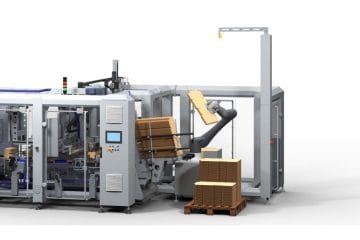
The FW746 model can be integrated into a monobloc robotic unit to create a complete packaging system. (photo: CAMA)
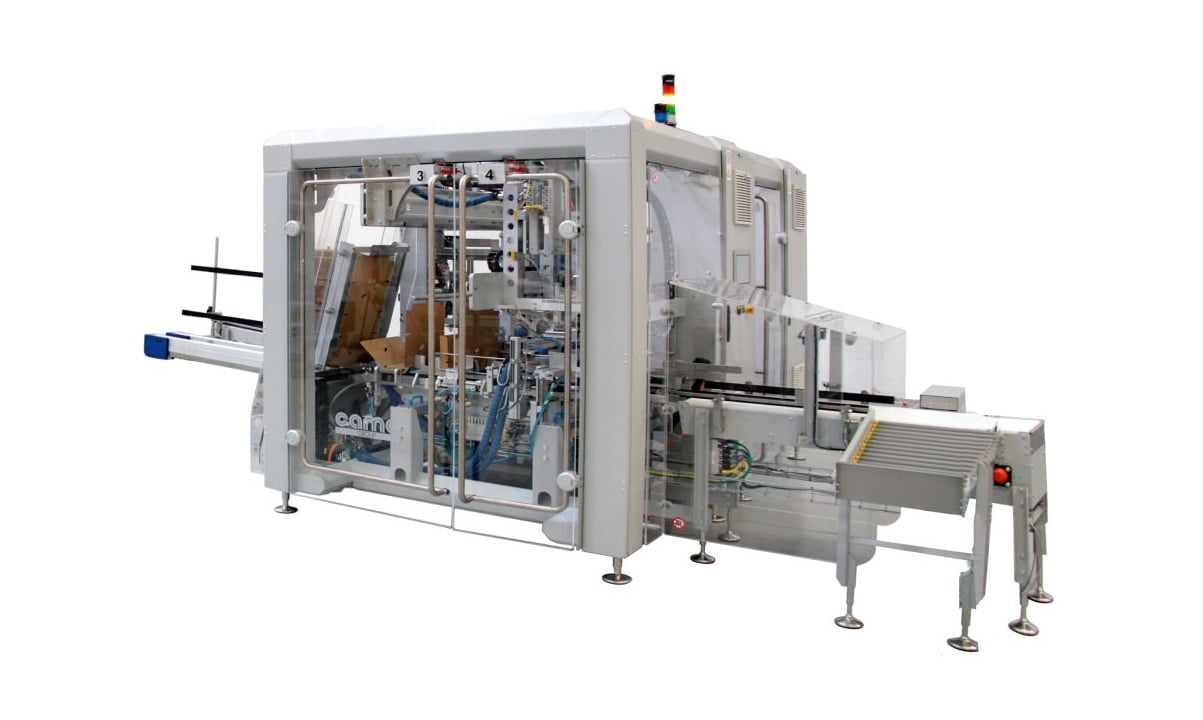
The FW746 model by Cama Group (derived from the FW748, standard machine) can create crates with dimensions up to a quarter of a pallet (400 X 300 mm) for products that require reduced packaging due to the demands of the large-scale retail trade.
“The spaces granted to various brands within supermarkets are increasingly limited, so reduced packaging is required,” Sergio Cornago explains. “This is simple with the FW746 model from Cama Group, which can carry out various packaging operations with undeniable advantages in terms of maintenance, spare parts, and assistance. It starts with two Cama Group FW746 machines at 240 pouches per minute, and with increased productivity, a third will arrive to reach 360 pouches per minute. With the new line, we can now produce both Shelf Ready Packaging (SRP) and collection of wrap around cases from a blank spread using a single machine for the two different packages”.
The FW746 model can be integrated into a monobloc robotic unit to create a complete packaging system with box formation, loading, and closing: the product enters with primary packaging, and the box exits ready for shipment.
A modern line’s operators are simply responsible for supplying consumables and monitoring the lines’ operation. The variety of formats necessitates intelligent product design. (photo: CAMA)
Recyclable vs. compostable
“Much effort is being made to introduce compostable packaging, but in reality, the packaging is not always fully compostable, which can lead to user confusion. It is sometimes preferable to use a fully recyclable product rather than a partially compostable one. This reflection must be done on an individual basis. What is certain is that we have been using cardboard and its derivatives for some time, and we work with the customer to create the most convenient packaging from many perspectives, and our solutions include the use of 100 percent ecologically sustainable materials“.
Packaging materials: the selection of a barrier for product life
“The variety of formats necessitates intelligent product design: you open the package, use what you need, and close it“. (photo: CAMA)
Cama plants make use of environmentally friendly materials derived from paper. Plastic materials have been phased out of the market. Cama has an advantage because it uses cardboard and its secondary packaging solutions are free of plastic.
“We often talk about environmentally friendly materials, but we need to understand how environmentally friendly a material truly is. Although some materials are mechanically recyclable with automated interventions, they are not always compostable and usable as garden compost. Human intervention, in conjunction with mechanical interventions, is frequently required in order to reuse the packaging and give it a second life (or yet another life). We are dealing with a delicate issue that has sparked numerous debates and will continue to do so,” Cornago di Cama emphasizes.
Furthermore, “it is necessary to preserve the product’s quality by creating a protective barrier, which is difficult to achieve with compostable materials.”
If the product requires a long shelf life (such as coffee or baby food that lasts more than a year), “a non-compostable barrier material (such as aluminum in coffee capsules) must be used, which necessitates careful consideration of which materials to use in primary and secondary packaging.”
With a single point of contact, you can go from secondary packaging to palletization
This complex plant’s client had a single point of contact. Clevertech, a specialist in end-of-line palletization, was the project manager, and the required system was built in collaboration with Cama Group, a specialist in secondary packaging.
Thanks to the two experts, secondary packaging with the end of line for palletization has evolved into a one-of-a-kind system. The integration of the various parts of the system was simple because it was entrusted to two partners who have been collaborating every day for a long time and have created a complete and highly efficient solution together.
The more complex the system, the more important it is for the individual parts to be closely connected in order to exchange products, data, and information without problems due to machine incompatibility. The line, in addition to having perfect integration of the individual parts, has been designed to work at about 70% of its potential so that there is potential to increase production without overloading the plant.