

“Packaging plays a fundamental role in sustainability. The real challenge lies in preventing product waste – especially food waste – caused by missing or inadequate packaging, while also avoiding excessive use of plastic. Coesia has set itself the goal of finding this ‘perfect balance’ and providing solutions that protect without relying on unnecessary or excessive packaging”.
by N.S.
Sustainability rules that work: pragmatic standards for industry
“Sustainability is often cited too vaguely; in fact, standards still don’t exist because no one has defined them. The first hurdle is semantic. Today the word ‘green’ can mean everything and its opposite,” Aiolfi observes.
To prevent the debate from remaining abstract, Coesia takes part in working groups of both Italian and European trade associations and, through its own experts, in consultations with the EU Commission. “The goal,” he explains, “is to connect political vision with technological feasibility—to translate guidelines into measurable, verifiable and, above all, applicable standards in the field.” This is no trivial task: over the past five years, regulation has often pushed beyond the limits of available technology, creating what Aiolfi describes as “a period of necessary utopia that is sometimes out of step with factory reality.” Today, the aim is to strike a more pragmatic balance, one that rewards innovation without undermining competitiveness.
From utopia to industrial practice: Coesia’s toolbox
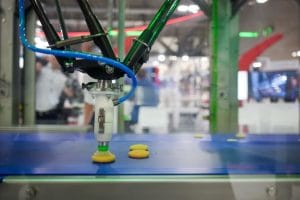
The initial enthusiasm – “everything had to become green right away” – was followed by a phase of disenchantment. Today, Aiolfi explains, the challenge is to bring sustainability from the theoretical level to the factory floor, “ transforming visions into machines, processes and business models that are economically viable. It often happens that a customer come to us with rather vague ideas on these topics. We have built a method that starts with packaging design – understanding how a new material folds, seals, and protects – all the way to verifying real-world performance.”
The group’s broad portfolio allows for cross-industry knowledge transfer between cosmetics, food and homecare: “solutions conceived for one sector can become inspiration in others, accelerating innovation.”
Sustainability factor: Yes, but with Coesia’s cost-effective green path
“Sustainability is real only if it is also financially sustainable,” Aiolfi stresses. Concretely, this means analyzing various economic and financial factors alongside material availability and market prices. “Sometimes converting to renewable packaging is intuitive; other times it requires compromises – thinning the film instead of changing it, improving logistics to reduce CO₂ emissions, or optimizing recyclability as an alternative to using a purely bio-based material.” Drawing on its network of competence centers, Coesia helps customers choose the path that maximizes the balance between environmental impact and economic viability and, when needed, suggests less costly alternatives without losing sight of the green objective.
Consumer evolution: the three-stage journey toward sustainable packs
The consumer’s evolution unfolds in three stages: the initial burst of enthusiasm, with “shoppers demanding the most eco-friendly packaging possible, regardless of cost”; the next, more realistic phase, where the focus shifts to “how much extra they are willing to pay and what truly benefits the environment”; and finally, the natural choice, when the sustainable option becomes the implicit norm. At this point, consumers prefer it when prices are equal or even with a small premium, often without realizing it. In this mature phase, Aiolfi observes, the consumer “determines the success of brands and, by extension, the projects that Coesia develops with its clients.”
Global market from Europe to Asia: Coesia aligns green packaging with local demands

Europe is the regulatory laboratory, with stringent standards on recyclability and reuse. North America is the market historically less interested in the environmental agenda, yet in the past three years it accelerated its sustainability targets only to slow down sharply following the recent change in administration. South America is entering a phase of growing interest, driven by rising purchasing power and government-led circular economy programs. Asia is a universe of its own, fragmented and contradictory: from Japan, committed to zero-carbon policies, to emerging countries where price remains the main driver.
“We study markets from the inside,” Aiolfi explains, “collect feedback and develop a differentiated offering for each geography. Our model places great emphasis on after-sales service (spare-parts warehouses, local technicians), which is strategically crucial for operating in such diverse markets. The model was first created for North America and provides shared spare-parts hubs across the group’s companies, multifunctional technical teams, and harmonized sales processes. By the end of the year, this model will be replicated in Indonesia—our gateway to South-East Asia—followed by India, and finally Brazil,” Aiolfi details. “Technical support is essential from a sustainability perspective because it allows customers to use their machines to the fullest, m waste or scrap.”
Asian markets: fragmentation and the green packaging challenge
How important is sustainability in Asian market competition? “In some regions, the green economy is almost a matter of prestige,” Aiolfi says. “Think of Korea or the urban areas of China: offering renewable packaging is a way of saying ‘I’m a premium brand, looking to the future’. At the same time, there are markets where sustainability is a secondary concern. In those contexts, the challenge lies in making sustainable packaging competitive without a price premium. The solution involves cost engineering, material optimization and, equally important, consumer education through partnerships with retailers”.
Concrete tools, not slogans to make green packaging viable in different markets
In a debate fueled by sometimes opposing ideas— encompassing sustainability as well as economic and social aspects—Coesia offers a balanced and practical solution. It is essential to define realistic standards together with institutions and industry, then translated into proven, economically sustainable solutions that can be sold in markets moving at different speeds.
“Success,” Luca Aiolfi remarks, “will be enabling consumers to ‘use’ something reusable or recyclable without wasting resources. If we achieve this, everyone wins: the environment, the consumer, companies and international competitiveness.
In this way, sustainability shifts from a vague label to becoming a daily practice and a driver of innovation. “The day consumers can choose a reusable or recyclable packaging without paying more and without sacrificing product quality,” Aiolfi concludes, “we will have reached the goal. We aim to get there first, offering companies concrete tools, not slogans.”