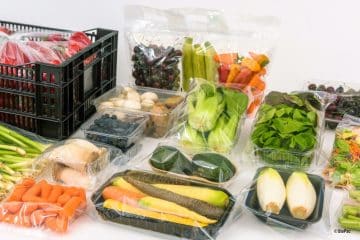


UrbanKisaan has optimized its hydroponic cultivation technology for use in tropical climates such as India.
(video: UrbanKisaan)
Greenhouses and vertical indoor farms in Hyderabad and Bangalore

Conceptualized in 2017, UrbanKisaan operates several suburban greenhouses and vertical indoor farms in Hyderabad and Bangalore. The company sells the fresh produce, some of which is grown directly in the shops, in its franchise-owned brick-and-mortar stores and via an app and website. Both parties agreed not to disclose financial details of the investment.
UrbanKisaan has optimized its hydroponic cultivation technology for use in tropical climates such as India. With only one tenth of the costs, the proprietary technology is significantly more efficient than conventional global standards in hydroponics cultivation. The company is also capitalizing on the trend of online food retailing, which is booming on the subcontinent. “Our approach in hydroponics enables us to produce our food cost-effectively and with relatively little effort,” said Vihari Kanukollu, co-founder and CEO at UrbanKisaan.
“Our produce also contributes towards sustainability as it is grown in clean, hygienic farms in and around the city, thus minimizing the total carbon footprint. Use of IoT (Internet-of-Things)-enabled technology for monitoring the farms ensures pesticide-free produce. The growing demand from our customers shows that our idea is well-received,” he added.
Developed a unique growing method for the hydroponic cultivation

UrbanKisaan’s farms are managed through their proprietary technology. Nutrient content, pH levels, atmospheric humidity, CO2 concentration, light concentration and other important parameters are controlled and adapted to the needs of the particular plants with an app.
“UrbanKisaan, as a pioneer in the hydroponics space, has developed a unique growing method and combines this with a compelling business model for sales,” commented Markus Solibieda, Managing Director of BASF Venture Capital GmbH.
He added: “AgTech is one of our key investment focus areas worldwide. This includes, in particular, our goal of supporting innovative agricultural and food-related businesses in Asia. We look forward to learning more about hydroponic farming and exploring its potential through a close collaboration between UrbanKisaan and BASF’s agriculture experts.”
With the investment from BASF, UrbanKisaan plans to further expand its market presence in India, deploy its farming technology to work with thousands of farmers, and bring fresh, local, sustainable produce to urban dwellers.
Hydroponic farming – an efficient way to use limited resources

The world’s population is expected to reach 10 billion by 2050(1) while the area available for farming and freshwater reserves are becoming increasingly scarce. Hydroponic cultivation offers a sustainable way to grow crops without soil and using vertically stacked layers while reducing water usage by about 90 percent(2). Especially in densely populated urban areas, this presents a more efficient way to use limited resources like water, space and manpower. Water that is not absorbed by the plants is captured, purified and fed back into the farm’s water circulation system, minimizing wastage significantly.
India is the second-largest producer of fruits and vegetables in the world, with a production value of about $64 billion. It is also a large consumer of fruits and vegetables, and while much of this is through unorganized channels (local vegetable markets, hand-pulled carts and neighborhood stores), organized channels (modern trade and online retail) account for a little over 20 percent of the market Thus, hydroponics is a fast growing and efficient alternative to traditional supply chains in the organized fresh produce market.
Info about UrbanKisaan
UrbanKisaan was conceptualized in 2017 in Hyderabad, India. The company began as a farming enterprise but wanted to grow more than just fresh and nutritious food. They wanted to create a sustainable future for farming and feed the world in a way that is good for both people and planet. Today, with its hyper-local urban farms the company is creating a transparent supply chain with a low carbon footprint, leveraging on proprietary growing technology that helps save 90% of water yet grow 30 times more crops compared to traditional farms of similar area.
(1) Reports from UN & IISD.
(2) Barbosa, Guilherme Lages et al. “Comparison of Land, Water, and Energy Requirements of
Lettuce Grown Using Hydroponic vs. Conventional Agricultural Methods.” International journal of environmental research and public health vol. 12,6 6879-91. 16 Jun. 2015, doi:10.3390/ijerph120606879