

by N. S.
In food packaging, the material is decisive because it determines the protection barrier and the shelf life of products, depending on whether it is paper, plastic, laminated material, aluminium, or other. In addition, materials and inks in contact with food must meet MOCA requirements, without forgetting the importance of their machinability.
In non-food packaging, the material has a similar technical role, but with different priorities: the focus is on mechanical strength and the protection of products during transport. In all cases, paper and plastic must be designed as functional systems, intended to work in synergy with the product and with the packaging machine.
Packaging sustainability and its environmental impact
“When talking about packaging sustainability, you must consider the entire life cycle of the material, from the origin of the raw material, whether renewable or fossil, to the quantity used, the possibility of recycling or reuse, the presence of recycled content, the energy for its production and transport, and CO₂ emissions. Packaging is truly sustainable if it protects the product, reduces waste, waste materials, and environmental impacts, without sacrificing safety and functionality.
Real recyclability is very important, so it is better to prefer mono-material systems instead of composite structures that are difficult to separate, certified or recycled raw materials, and weight reduction with the same performance. Paper, although perceived as more “natural” than plastic, is sustainable only if it comes from responsible supply chains. Plastic can be optimised with recycled content and with structures designed to facilitate collection and recycling. Completing the picture is communication to the consumer, with simple instructions on separate waste collection and transparent messages about what makes that packaging sustainable”, explains Marco Tanzi of Cama.
Marketing-oriented packaging: material structure, barrier performance, and sustainability

“Packaging is a marketing-oriented design tool: it is the first contact between the consumer and the product, what is seen and touched even before the content. The choice of packaging material directly influences ergonomics and functionality of use. Opening, reclosing, dosing, grip, zip closures, transparent windows, handles, and reinforcements depend largely on the substrate used and on its folding, die-cutting, and holding capabilities.
In marketing-oriented packaging, the material is linked to consumer needs: product safety, waste reduction, shelf life, sustainability, and user experience. Barrier performance and shelf life derive from the structure and from any composite layers. Efficiency in the machinability of the pack is linked to optimised materials. Sustainability comes from mono-material solutions, from recyclability, and from recycled content,” explains Nadia Comi.
All these elements define a true integrated packaging system, in which product, material, machine, and logistics are designed together to achieve high performance and consistency throughout the entire supply chain.
Recycled paper and recycled plastic in packaging: market trends and the role of machines
The packaging market is experiencing a strong transition toward more sustainable materials. This evolution is driven by consumer expectations and by European regulations, in particular the PPWR, the regulation that governs packaging and packaging waste. “Those who package products ask how the use of materials will change on existing lines and whether packaging machines will be able to maintain the same performance with different substrates.” More and more companies are replacing traditional materials with recycled paper and recycled cardboard, in the search for sustainable packaging materials.
The same dynamic concerns plastic, where “pure” material is progressively being abandoned in favour of solutions with increasing percentages of recycled content. In this context, Cama designs packaging machines prepared to use different types of materials, in order to support customers in using recycled packaging on existing lines. The company often works together with paper-converting companies to build a correct product–packaging system, functional to market needs and consistent with sustainability objectives.
“Packaging offers are increasingly often structured into two alternatives: a version in virgin paper or virgin cardboard, designed to achieve a specific aesthetic result, and a version with recycled materials but with the same functional performance, which enables environmental savings. If previously the standard solution was virgin material, today priority has shifted to recycled materials,” as Tanzi highlights, “marking a real change of paradigm in the packaging world.”
Limits of recycling paper and plastic in packaging: what you need to know

In sustainable packaging, the recycling of paper and plastic has technical limits that cannot be ignored. Paper can be recycled for a finite number of cycles, because the fibres shorten, weaken, and lose strength. Plastic also, with subsequent processing, degrades its own properties. To maintain packaging quality, it is often necessary to integrate a share of virgin material. Packaging design must therefore find a balance between sustainability, line performance, and the intrinsic constraints of recycled materials.
In paper recycling, cellulose fibres degrade at each cycle: they shorten, lose strength, and make recycled paper progressively less high performing. On average, a fibre can be recycled up to about seven times, then it becomes too damaged for further uses in packaging. To maintain quality and performance, especially in packaging, it is necessary to continuously add a share of virgin raw material, which compensates for the loss of mechanical characteristics of the recycled material.
For plastic, recycling limits depend on the wide variety of polymers and on their molecular degradation during processing. Heating shortens polymer chains and reduces their properties, so different types of plastic can be recycled only a few times. PET for bottles is an exception, even if a part of the material is still lost during the recycling process. In general, mixing different plastics, multilayer structures, and contamination with other residues make recycling very difficult: in these cases, part of the waste ends up in landfill, limiting the possibility of truly closing the packaging cycle.
In this context, those who design packaging must bring together quality, safety, and performance with the technical limits of recycling paper and plastic, knowing that the contribution of virgin material remains indispensable to ensure reliable and functional packaging.
How packaging is changing for global markets: recycled content, e-commerce, and logistics
International trends in packaging are converging toward a common objective: combining sustainable packaging, technical performance, and consumer expectations.
“More and more markets, including Asian and South American countries, are asking for packaging with recycled content and lower-impact materials, such as recycled papers and cardboards, bioplastics, and biomaterials. One of the main directions is the shift from complex structures to mono-material packaging in paper, cardboard, or recyclable plastic, often with a ‘paperisation’ approach of packs previously made in plastic, thanks to new coatings and barrier films that still allow good product protection,” continues Tanzi.
“In parallel, packaging is being optimised for e-commerce and global logistics. Lighter and more compact packs are designed, resistant to stresses but with less volume, padding, and waste, and fully compatible with automatic machines, palletising, and automated warehouses. On the design and marketing side, packaging is a strategic means of communication: graphics, sustainability and the origin of materials, personalisations, and smart packaging solutions guide the consumer and tell the product. For industry, this translates into an integrated approach to packaging, in which material, paper converting, the packaging line, and the brand promise are designed together to be competitive at a global level”.
Designing packaging for transport: logistics testing and resistance

Designing packaging for the transport of goods means finding the right balance between mechanical strength, logistics efficiency, and shelf appeal.
“A well-designed pack protects the product throughout its journey: it absorbs shocks and vibrations, resists compression and climatic variations, and maintains stability on the pallet and inside containers, reducing the risk of damage and returns. In the case of corrugated board, for example, the combination of paper quality and flute types determines the final robustness, so structure and material cannot be chosen ‘at a glance’.
The solution comes from an integrated approach to packaging for transport, involving the machine manufacturer, the paper-converting company, and the customer. The product, the role of the packaging (transport, display, marketing), the logistics route, and resistance requirements are analysed, to obtain packs that work well during the journey and are consistent with the brand image on the shelf,” Tanzi highlights.
“To verify that packaging can really withstand transport on pallets, specific tests on the packaging are used. Compression tests serve to define the stacking height. Vibration tests simulate continuous movements on trucks, trains, or ships. Transport tests combine, in a single cycle, compression, vibration, shocks and, if necessary, variations in temperature and humidity. Crash tests, finally, simulate accidental drops or impacts.”
These tests become crucial when high pallets loaded automatically are used, which increase the load on the lower layers. Test results make it possible to compare materials, thicknesses, and structures, optimize reinforcements and accessories (corner protectors, stretch film), and introduce lighter and more sustainable packaging without increasing the risk of damage. Investing in compression tests, vibration tests, transport tests, and crash tests means reducing returns and complaints, making pallet transport more reliable, and improving the overall efficiency of the logistics chain.
Packaging as a synergistic system: converting, materials, and the packaging line

“Collaboration between the paper-converting company and the packaging machine manufacturer is decisive to design paper and cardboard packaging that works reliably on automatic lines and throughout the entire logistics.
The paper-converting company knows materials, cardboard flutes, dies, and closing systems, while the machine manufacturer defines speeds, tolerances, and mechanical limits. Only by integrating these skills can robust and efficient packs be achieved, consistent with marketing needs. In practice, good packaging system design allows cardboard boxes, cartons, and trays to be formed, filled, and closed automatically without jams. This reduces waste, line stops, and problems in palletizing, and ensures that the product arrives intact at the point of sale,” underlines Nadia Comi. “For this reason, companies such as Cama work increasingly often with paper-converting companies and paper producers, sharing from the beginning the choices on structure, flute type, dimensions, and transport conditions, also according to the different conditions of international markets.”
When this collaboration is missing, the risk is choosing cheaper but less high-performing cardboard, with deformations, damage, returns, and additional costs. On the contrary, a coordinated project between the machine, the paper-converting company, and the customer makes it possible to define cardboard packaging sized to the real transport conditions and to the required standards, including those required by multinationals. The result for the final customer is reliable and sustainable packaging, aligned with the brand image in global markets.
Storing paper and cardboard for packaging: practical warehouse and pallet rules
Nadia Comi explains the importance of “correctly storing paper and cardboard for packaging means keeping them in controlled and stable environmental conditions. Humidity, temperature, and storage methods affect flatness, shape, and machinability: if the material deforms, problems appear in printing and on packaging machines. To avoid this, pallets must be kept under cover, in dry environments, far from cold, humidity, direct sunlight, and heat sources, raised off the ground, spaced away from walls and air currents, and protected until use with film, straps, and plywood boards. The way sheets, die-cuts, and cartons are stored is also decisive: sheets well laid flat, cartons stored vertically, no loose bulk loads, and no compression in the wrong direction, in order not to damage the pre-breaks. Good stock management, with a “first in, first out” logic and acclimatization of pallets in the production area, reduces degradation over time and improves machine behaviour.
In food packaging, it is also important to avoid proximity to chemical or odorous products. By following these rules, consistent performance is achieved, with fewer scraps and line stops, and packaging that reaches the customer with the quality expected at the design stage”.
Material machinability in packaging: what it is and why it affects line performance

The machinability of materials in packaging is the ability of paper, cardboard, or plastic to run in a stable and continuous way on automatic machines: the material must feed correctly, maintain flatness, fold at the established creasing points, and close without defects.
“When it is deformed, too light, irregular in thickness, or sensitive to humidity, jams, stops, scrap, and slowdowns increase, with a direct impact on line performance. For this reason, preliminary tests with the real materials are always required: starting from the first samples cut with a plotter to verify shape and closure, then samples suitable for mechanization to check grip, forming, and closing on the machine. These phases make it possible to correct closures, tabs, and creases before large productions and to avoid large-scale errors. Every change of material, for example the introduction of recycled content or different cardboards for cost or recyclability needs, requires tests and a machine adjustment, because machinability comes from the balance between material, paper-converting design, and line parameters,” explains Marco Tanzi.
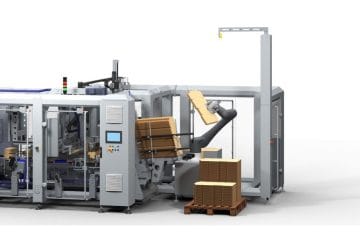
“Cama machines are highly flexible and quickly configurable to handle the machinability of a wide range of cartonboards and corrugated boards in the packaging process. Taking care of material machinability with targeted tests and continuous dialogue between the customer, the paper-converting company, and the machine manufacturer makes it possible to increase packaging speed, reduce scrap and stops, and ensure packaging of consistent quality, turning material choice into a real competitive advantage.”
Adhesives for paper, cardboard, and plastic packaging: which technical data to check
When designing packaging, it is essential to consider the adhesive as part of the system and its contribution to pack sealing. In food packaging, in addition to technical performance, MOCA requirements (Materials and Articles in Contact with Food) also come into play. The adhesive must guarantee low odour, low migration, and complete compliance documentation, to ensure packaging that is safe and compliant with regulations.
The main trends go in two directions: more sustainable adhesives with a lower environmental impact, and formulations designed to facilitate the recycling of paper and plastic. In food, beverages, and cosmetics, demand is growing for low-odour and low-migration adhesives, which combine content safety and the aesthetic quality of closures.
EU packaging regulations: primary, secondary, end-of-line, food and non-food
For all packaging (paper, cardboard, plastic, primary, secondary and tertiary), the historical reference is Directive 94/62/EC on packaging and packaging waste. It defines primary, secondary and tertiary packaging and introduces the essential requirements (minimization of weight/volume, limitation of hazardous substances, recyclability, recovery, and recycling targets by material).
This directive is replaced by Regulation (EU) 2025/40m the PPWR (Packaging and Packaging Waste Regulation), adopted on 19 December 2024, in force from 11 February 2025, and it will apply in a general way from 12 August 2026. It is a regulation: therefore, it will be directly applicable in all Member States and it will repeal Directive 94/62/EC from the date of application.
The objectives of the PPWR for all levels of packaging (primary, secondary, end-of-line) and for materials are:
- to make packaging recyclable in an economically sustainable way
- to reduce the amount of packaging waste
- to increase recycled content in packaging
- to decrease the use of virgin raw materials
In practice, for paper and plastic this means that:
- Every packaging item (cartons, trays, pouches, shrink films, transport boxes) will have to be designed for recycling, with technical criteria that will be defined by delegated acts by 2028.
- All packaging levels (primary, secondary, tertiary) fall within the scope, with requirements on prevention, recyclability, reuse, recycled content, and marking.
For primary paper and plastic packaging in contact with food
PPWR requirements are combined with MOCA rules for food-contact materials (including paper and plastic):
- Regulation (EC) No 1935/2004 on materials and articles intended to come into contact with food (the material must not release substances in quantities that could endanger health or cause an unacceptable change in the composition, odour, or taste of the food).
- Regulation (EC) No 2023/2006 on Good Manufacturing Practice (GMP) for MOCA, also applicable to manufacturers of paper, cardboard, and plastic for food packaging.
For food contact plastics, there is harmonised EU legislation:
- Regulation (EU) No 10/2011 on plastic materials and articles intended to come into contact with food (with the Union list of authorised substances, migration limits, the declaration of compliance, and technical documentation for plastic packaging in contact with food).
This regulation is updated periodically; therefore, it is important to verify its updates.
Paper and cardboard for primary food packaging
For paper and cardboard, as of today, the EU still does not have a specific harmonized measure like it does for plastic. Regulation 1935/2004 and Regulation 2023/2006 apply, which require ensuring the safety of the material and the adoption of GMP (Good Manufacturing Practices). In the absence of a specific EU measure, there are different indications for different countries.
Secondary packaging in paper and plastic
Secondary packaging (cartons, clusters, boxes that contain multiple sales units) is generally not in direct contact with food, but it fully falls within the scope of Directive 94/62/EC / PPWR for all aspects of waste, recycling, reduction, labelling, and it may indirectly fall under Regulation 1935/2004 if there is a risk of migration through the primary packaging, especially if the primary packaging is very thin or porous.
The PPWR also introduces the concept of “contact sensitive packaging”, i.e. packaging (often made of plastic) intended for food products, feed, and other regulated products, with more stringent requirements, for example on the minimum recycled plastic content.
For secondary plastic (shrink film for bundles, handles, etc.), it is therefore important to assess whether or not it falls within the categories of contact sensitive plastic packaging and the mandatory recycled content targets for 2030 and 2040 set by the PPWR for the different types of plastic packaging.
End-of-line / tertiary packaging (transport and logistics)
End-of-line packaging in paper and plastic is classified as tertiary packaging. At EU level it is subject to the same rules on packaging and packaging waste: first Directive 94/62/EC, then the PPWR.
Tertiary packaging falls within the recyclability targets for 2030 and the recycled content targets for plastic components; it must also comply with the requirements for prevention, reduction, and optimization of packaging along the entire supply chain. Usually, tertiary packaging is not considered MOCA, but if it comes into direct contact with bulk food (e.g. large inner bags), the rules of Regulation 1935/2004 and the related specific measures become applicable again.